Caridina Shrimp Care: Crystal Red and Taiwan Bee Guide
Caridina shrimp such as Crystal Red, Crystal Black and the Taiwan Bee lines are among the most eye-catching animals in the hobby thanks to their patterns and colors. In return, they ask for more care: soft, slightly acidic water and, above all, stable water.
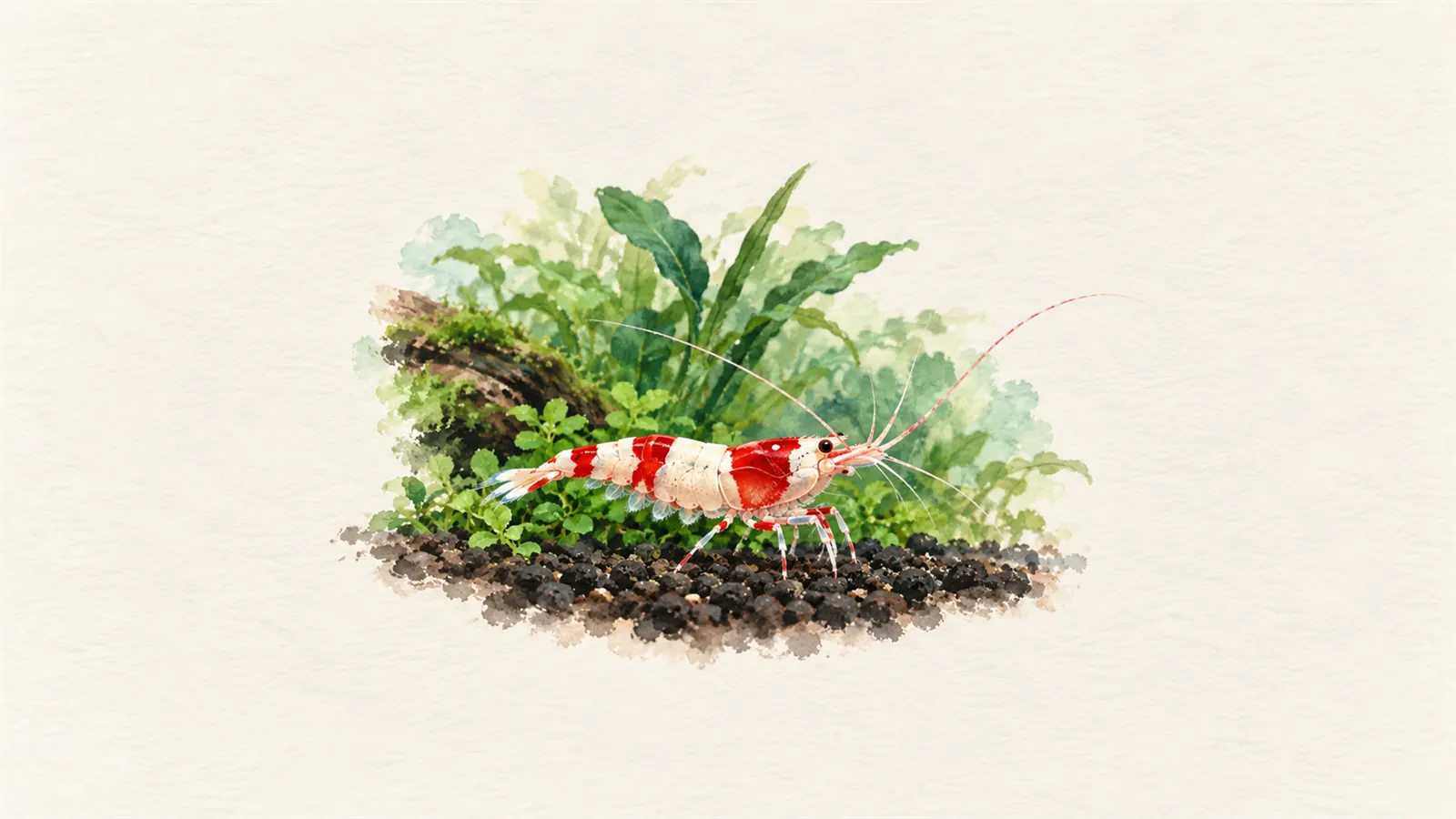
Caridina water parameters: target values
These are the ranges commonly accepted for Caridina cantonensis forms (Crystal and Bee lines):
| Value | Target range | Note |
|---|---|---|
| Temperature | 20–23 °C (68–73 °F) | Above 25 °C (77 °F) is risky |
| pH | 5.8–6.8 | Many breeders prefer 6.0–6.5 |
| GH | 4–6 | Minerals needed for molting |
| KH | 0–1 | Kept low so it does not push pH up |
| TDS | 100–160 ppm | Measured to set the mineral dose |
| Size | 2–3 cm (0.8–1.2 in) | Varies with line and feeding |
These numbers are a starting point; what really matters is how little they move from week to week. Use liquid test kits and a calibrated TDS meter; test strips are not reliable at this level of precision.
Which shrimp does this guide cover?
This guide covers the most common Caridina group in the hobby, Caridina cantonensis forms: Crystal Red (CRS), Crystal Black (CBS) and Taiwan Bee lines such as Blue Bolt, King Kong, Panda, Wine Red and Shadow. Tiger shrimp and tiger/bee hybrids are kept in similar conditions.
Sulawesi shrimp are also Caridina but need something completely different: warm water with a high pH. They are outside the scope of this guide.
What makes Caridina harder to keep?
Neocaridina adapt to most tap water, while Caridina want soft, slightly acidic water. The real challenge is their sensitivity to change: sudden swings in pH, temperature or TDS can lead to molting problems and losses. That is also why KH is kept near zero: KH pushes pH up, against the slightly acidic conditions Caridina want.
Water: RO and remineralizer
In most areas tap water is too hard for Caridina, and its values can change with the seasons. That is why most breeders use RO (reverse osmosis) water with a Caridina remineralizer that raises GH only (no KH). Dose it with a TDS meter until you reach your target TDS. Neocaridina remineralizers that also raise KH are not suitable for a Caridina tank.
Mix the water in a separate container, not in the tank, and wait for the mineral to dissolve completely. The prepared water should be within your target TDS and at tank temperature. Calibrate your TDS meter regularly; a wrong reading quietly leads to the wrong mineral dose.
Active substrate
Caridina tanks usually use active substrate. It lowers pH and holds it within a range; with KH near zero, it is the main thing keeping pH stable.
Active substrate can release ammonia in the first weeks, so cycling usually takes longer. Confirm ammonia and nitrite are at zero before adding shrimp. Its buffering capacity fades over time, usually noticeably within one to one and a half years. If you see pH slowly creeping up, plan to replace the substrate.
Water changes and evaporation
Keep water changes small and regular; about 10% a week is a common approach. Never use new water before matching it to the tank's TDS and temperature. Add it slowly, ideally through thin tubing or drip by drip.
Top off evaporation with pure RO water with no minerals added. Minerals stay in the tank when water evaporates, so topping off with remineralized water keeps pushing TDS up. Marking the water level makes it easy to see how much you have topped off.
Temperature
Caridina like cool water. Temperatures above 25 °C (77 °F) can cause stress and losses. A small fan blowing across the surface can lower the temperature by a few degrees; it also increases evaporation, which makes the RO top-off rule even more important. If you use a heater, choose a reliable model with a thermostat; in a small tank, a heater that fails can quickly be deadly.
Acclimation and feeding
Drip acclimate Caridina more slowly than Neocaridina; if the TDS and pH of the water they came in differ from yours, spread it over 2–3 hours. Release new shrimp with the lights dimmed and do not feed on the first day.
Feed sparingly; excess food fouls the water and raises TDS. If the tank has enough biofilm, leaves and plants, the shrimp graze all day anyway. Copper-based medications and many parasite treatments are lethal to shrimp; always research how any chemical affects shrimp before adding it.
Step by step: setting up a Caridina tank from scratch
- Choose the tank and equipment: 20 liters (about 5 US gallons) or more, a sponge filter or other low-flow filter and a lid to reduce evaporation.
- Lay the active substrate in an even layer without rinsing it.
- Prepare RO water, bring it to your target TDS with a GH remineralizer and measure the pH.
- Add plants and decor, leaving hiding places for the shrimp.
- Cycle the tank: wait until ammonia and nitrite are at zero; with active substrate this can take several weeks. See the tank cycling guide.
- When the cycle is done, do a large water change and test again.
- Drip acclimate the shrimp and add them.
- Test often in the first weeks and keep water changes small.
- Once settled, change about 10% weekly and top off evaporation with pure RO water.
Common mistakes and how to avoid them
- Starting with tap water: start with RO water and a GH remineralizer; only consider tap water after testing it.
- Using a remineralizer that raises KH: choose one that raises GH only.
- Large water changes: stay around 10% a week and add the water slowly.
- Topping off with remineralized water: always replace evaporation with pure RO water.
- Adding shrimp before the cycle is complete: wait until ammonia and nitrite are zero.
- Letting the tank go above 25 °C (77 °F): use a fan and keep the room cool.
- Overfeeding: feed little and watch for leftovers.
- Using products with copper: never use anything containing copper in a shrimp tank.
Symptoms and checklist
| Symptom | Possible cause | What to do first |
|---|---|---|
| Hanging at the surface or along the edges | Low oxygen, high temperature, water quality | Check temperature and ammonia, add aeration |
| Deaths during molting, white ring | GH or TDS swings | Test GH and TDS, match new water to the tank |
| No appetite, inactive | Stress, a sudden change in values | Review your last change, dim the light |
| Mass losses | Ammonia/nitrite, medication, copper | Test, and question everything that went into the tank |
| Algae bloom | Too much food, too much light | Cut back food and lighting hours |
Tips for beginners and experienced keepers
If you are just starting
Getting some experience with a Neocaridina tank before Caridina makes things much easier. When you move to Caridina, start with one tank and do not rush. For your first shrimp, choose a healthy group raised in water close to yours rather than the most expensive line. Keep spare RO water and remineralizer on hand, and keep a simple log: date, TDS, pH, temperature and how much water you changed.
If you are experienced
Check the TDS of every RO batch and adjust the mineral dose to the tank's needs. Track how much buffering life your active substrate has left by watching the pH trend. If you breed selectively, keep lines in separate tanks and observe newcomers in a separate tank for a while first.
Frequently asked questions
Can I use tap water for Caridina?
In most areas tap water is too hard for Caridina and has too much KH, and its values change with the seasons. That is why RO water with a GH-only remineralizer is recommended. If you want to try tap water, test GH, KH, pH and TDS first.
Why should KH be near zero?
KH pushes pH up and buffers it against change. In the slightly acidic water Caridina want, high KH drives pH up and uses up the active substrate's buffering capacity faster. Keeping KH at 0–1 makes it easier to hold pH in the target range.
How often should I change the water?
In an established tank, about 10% a week is common. In the first weeks after adding shrimp, keep changes even smaller. The rule is: never make the values jump.
Why can't my shrimp molt?
The most common causes are GH and TDS imbalance and sudden changes. If GH is too low the shell is weak; if it is too high the old shell is hard to shed. Match new water to the tank, measure your minerals regularly and keep the temperature stable.
Is copper really that risky?
Yes. Shrimp are very sensitive to copper, and copper-based medications or additives can be lethal. Read the ingredients of everything you add to the tank; if you are not sure, leave it out.
The values and advice in this guide reflect what is widely accepted in the shrimp hobby. They can vary with the line, your water and the breeder your shrimp came from. Make changes to your tank in small steps.