Amano Shrimp Care: The Algae-Eating Shrimp Guide
The Amano shrimp is known as the "algae cleaner" of the aquarium world. It became famous when the Japanese aquascaper Takashi Amano used it for algae control in his planted tanks. It is a hardy, long-lived, hard-working shrimp, but it differs from the cherry shrimp in a few important ways. In this guide you will find its water parameters, diet, how to acclimate it and the most common mistakes.
Amano shrimp water parameters
Amano shrimp adapt to a wide range, which makes them forgiving for beginners. But "adapts" does not mean "tolerates anything". What really matters is that values stay stable for days and weeks. Sudden pH drops, temperature swings and large water changes stress Amanos too.
| Value | Range | Practical note |
|---|---|---|
| Temperature | 20–27 °C (68–81 °F) | Water above 27 °C for long periods holds less oxygen and increases stress. |
| pH | 6.5–7.8 | Avoiding swings matters most. |
| GH | 4–10 | Enough minerals are needed for molting. |
| KH | 1–6 | Very low KH can make pH unstable. |
| Size | 4–5 cm (1.6–2 in) | Almost twice the size of a cherry shrimp. |
| Lifespan | 2–3 years, sometimes longer | Reaches the upper end with good care and stable water. |
As with every shrimp, ammonia and nitrite must be zero for Amanos. Keeping nitrate low protects both the algae balance and the shrimp's health. See the water parameters guide for details.
Getting to know the Amano shrimp
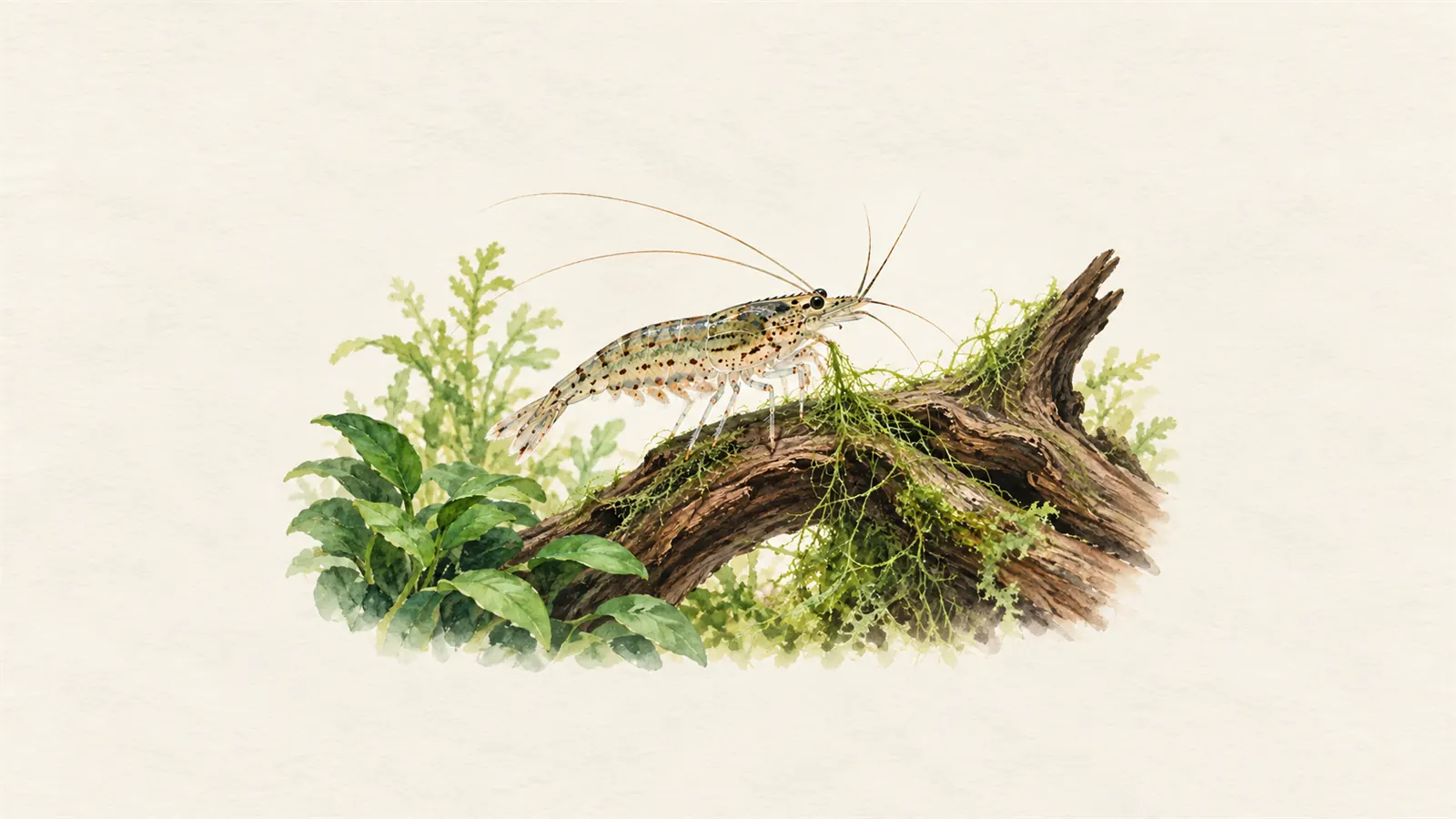
Amano shrimp have a semi-transparent, grayish-green body with small reddish-brown dots or dashes along the sides. They grow to 4–5 cm, and that size lets them live safely with many community fish.
Females are larger and the dots on their sides form long dashes; in males the dots are shorter and spaced apart. A female carrying eggs has a clearly wider underside. Sexing young shrimp is difficult.
What do they eat? Do they really clean algae?
Yes, the Amano is one of the most effective shrimp against algae. It especially clears hair algae, soft green algae and biofilm. But it does not eat every type; it barely touches hard algae such as black beard algae (BBA). Thinking of the Amano as something that wipes out all algae leads to disappointment; it is a cleanup crew, not a magic fix.
Amanos have big appetites, and if there is not enough algae left they may start nibbling the soft leaves of plants. When algae run low, feed them prepared shrimp food, sinking algae wafers and blanched vegetables (spinach, zucchini); remove uneaten pieces within a day. For feeding details see our shrimp food guide.
Amanos are quite dominant at feeding time and may grab food and run. If cherry shrimp share the tank, spread the food over several spots, or there will be almost nothing left for the small shrimp.
How many should I get?
As a general guide, one or two Amano shrimp per 20–40 liters (5–10 US gallons) is enough. Larger tanks with a clear algae problem can take more. Amanos are bolder and come out more often in small groups, so if your tank is big enough, choose a small group rather than a single shrimp. Putting too many in a small tank leads to them damaging plants once the algae is gone.
How to add Amano shrimp to a tank, step by step
- Make sure the tank is established. A tank that has not finished cycling and has no biofilm is not suitable for Amanos. See the tank cycling guide.
- Match the temperature. Float the sealed bag in the tank for 15–20 minutes.
- Drip acclimate. Put the shrimp and their water in a clean container and slowly add tank water. Take 1–2 hours in total; this softens differences in pH and hardness.
- Move them with a net. Net the shrimp into the tank; do not pour the transport water in.
- Dim the lights for the first hours. The shrimp may hide until they settle in; this is normal.
- Do not feed on the first day. If there is biofilm and algae in the tank, they will feed on that. Start with a small amount of food the next day.
- Watch the water in the first week. Check ammonia and nitrite, and avoid sudden temperature changes and large water changes.
What fish can they live with?
Thanks to their size, they generally live without problems alongside peaceful community fish such as neon tetras, rasboras, corydoras, guppies and small gouramis. Keep them away from angelfish, large cichlids and goldfish. For a detailed list, see our tank mates guide.
| Risk | Examples | Why |
|---|---|---|
| Usually compatible | Neon tetra, rasbora, corydoras, guppy, small gouramis | Small mouths and peaceful behavior |
| Use caution | Barbs, large and boisterous community fish | Harassment, food competition and stress |
| Not suitable | Angelfish, large cichlids, goldfish | May see the shrimp as food |
Can Amano shrimp be bred at home?
Amano females carry eggs in fresh water and the eggs do hatch. But unlike cherry shrimp, the young hatch as larvae. In the wild these larvae drift from rivers to the sea and complete their development in salt or brackish water. In a freshwater aquarium the larvae die within a few days.
Breeding at home is possible in theory, but you need to move the larvae to a separate saltwater tank, feed them microfoods for weeks and then slowly acclimate them back to fresh water. It is an advanced project, which is why most Amanos for sale come from commercial facilities. Do not expect Amanos to multiply in your tank; think of them as a cleanup crew, not a colony.
Common mistakes and how to avoid them
- Putting them straight into a new tank. In a tank without a finished cycle or biofilm, Amanos risk both poisoning and starvation. Let the tank settle and wait a few weeks.
- Skipping drip acclimation. Sudden differences in pH and hardness are one of the most common causes of early losses.
- Not using a lid. Amanos can climb out of the tank, especially when water quality drops or when they are new. Close even small gaps.
- Using medications or fertilizers with copper. Copper is toxic to Amanos too; always read the ingredients.
- Overfeeding. Leftover food fouls the water and raises nitrate.
- Large, sudden water changes. Small weekly changes are safer than occasional big ones.
- Forgetting to feed once the algae is gone. When algae runs low, extra food is essential, or the plants will suffer.
Health checklist
- Are they active and interested in food at feeding time?
- Do they graze surfaces during the day, or hide in the same corner all the time?
- Are there whitish patches or irregularities on the shell?
- Do you see an empty shell now and then?
- Are they trying to climb out of the tank?
- Are ammonia, nitrite and temperature stable?
If a shrimp is hiding, ignoring food or trying to escape, check the water first. Seeing an empty shell is normal; details in the molting guide.
Tips for beginners and experienced keepers
If you are new: get a number of Amanos that suits your tank size; do not skip the lid, do not rush drip acclimation and avoid large water changes in the first week. Keep anything containing copper away from the tank.
If you are experienced: treat Amanos as part of your algae balance; feed more when the algae is gone, and if algae explodes, review your light and nutrient balance. Factor in competition with other algae eaters such as snails and otocinclus. If you want to try raising larvae, do not start without a separate tank, a gradual salinity plan and a microfood routine.
Amano or cherry shrimp?
| Feature | Amano shrimp | Cherry shrimp |
|---|---|---|
| Size | 4–5 cm | 2–3 cm |
| Algae cleaning | High | Medium (mostly biofilm and soft algae) |
| Color | Transparent, grayish-green, dotted | Red and dozens of color lines |
| Breeding at home | Very hard (larval stage) | Easy |
| Tank with fish | Better suited | Risky for babies |
If your goal is algae control in a community tank with fish, the Amano is the better choice. If you want to build and breed a colorful colony, the cherry shrimp is the right pick.
Frequently asked questions
How long do Amano shrimp live?
Usually 2–3 years, sometimes longer with good care and stable water. Sudden water changes and high temperatures shorten their lives.
Can an Amano shrimp live alone?
Yes, but in a small group they are more relaxed and come out more often. Adjust the number to your tank size.
Are Amano shrimp safe with fish?
Usually yes with small, peaceful community fish. Species such as angelfish, large cichlids and goldfish may see shrimp as food.
Why do Amano shrimp escape from the tank?
The most common reasons are the stress of a new environment, declining water quality and a missing lid. Use a lid and check your water.
Do Amano shrimp lay eggs?
Females carry eggs in fresh water and the eggs hatch, but the larvae need salt or brackish water and do not survive in a freshwater tank.
Do Amano shrimp eat black beard algae?
Hardly. They are most effective against hair algae, soft green algae and biofilm. For hard algae, you need to fix the light and nutrient balance.
The values and advice in this guide reflect what is widely accepted in the shrimp hobby. They can vary with the line, your water and the breeder your shrimp came from. Make changes to your tank in small steps.