Shrimp Molting: Normal or a Problem?
Did you panic one morning, thinking you saw a dead shrimp, only to find on closer look an empty, transparent shell? Do not worry, your shrimp is growing. Molting is one of the most important and least understood parts of shrimp care. In this guide you will find the process, the difference between normal and abnormal, and how to keep your colony safe, step by step.
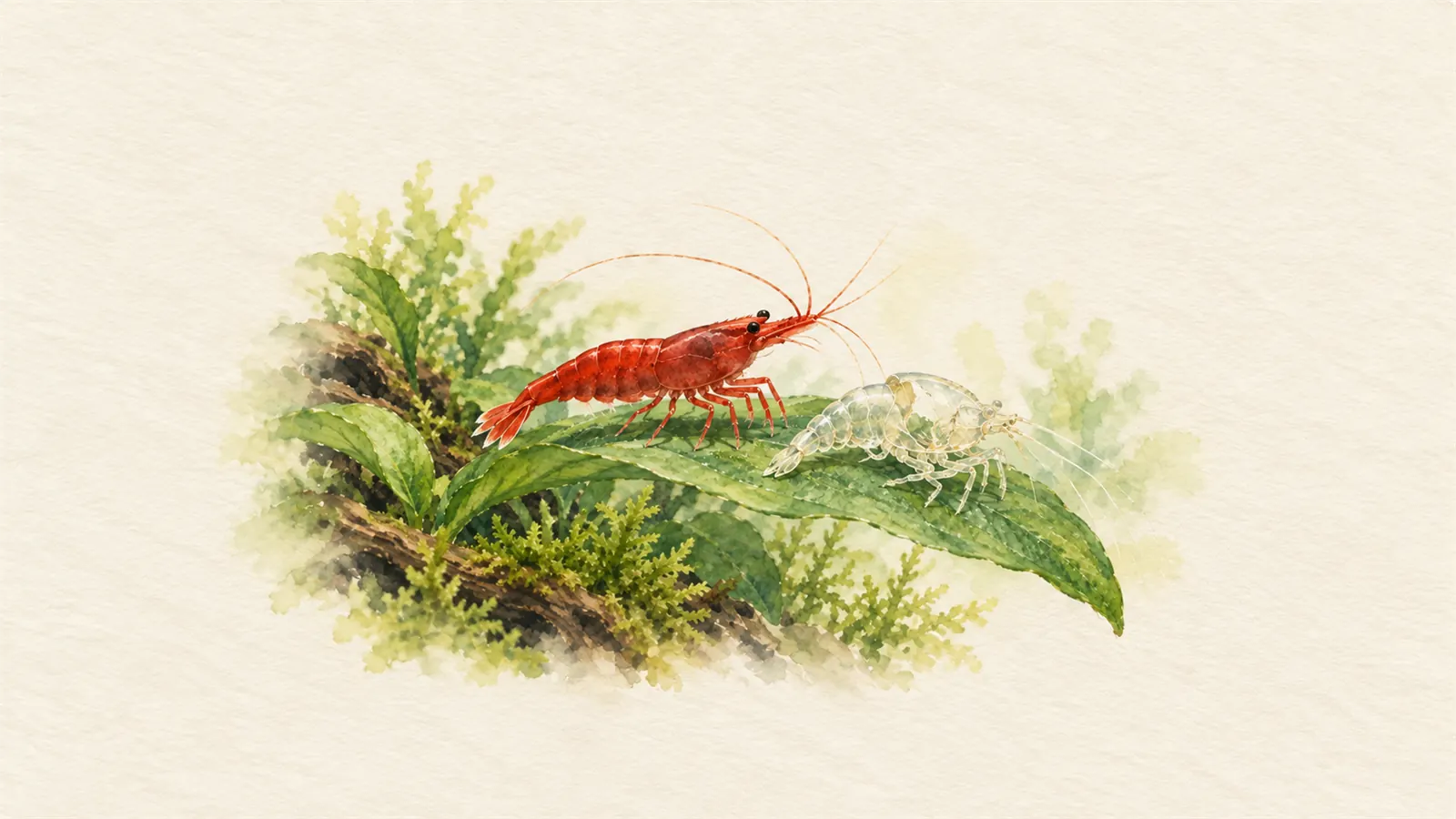
What is molting?
A shrimp's body is covered by a hard exoskeleton, its shell. The shell does not grow. As the shrimp grows, it sheds the old shell and the new, soft shell formed underneath hardens. This process is called molting.
Molting is needed not only for growth but also for breeding: females mate right after molting. A lost leg or antenna can also grow back over the next molts.
Why molting is so critical
Molting is one of the most vulnerable moments in a shrimp's life. When the old shell splits and the new one has not hardened yet, the shrimp is soft, unprotected and slow. During these hours, swings in water values, tank mates or sudden stress can be fatal. That is why experienced keepers see molting as a "stress test": a problem already present in the tank often shows itself for the first time at this moment.
The stages of molting
The process happens in four stages. Knowing them helps you interpret what you see in the tank correctly.
- Preparation: the shrimp reabsorbs some of the minerals in its old shell and forms a new, soft layer underneath. Its appetite drops, it moves less and tends to hide.
- Separation: the old shell separates from the new one underneath.
- Exit: the shrimp splits the old shell behind the head and quickly slips out backwards, then takes in water to expand its new shell. This moment is usually missed; most of the time you only see the result, the empty shell.
- Hardening: the new shell is soft for the first hours; it can take up to a day to harden fully. During this time the shrimp hides and may not eat. The shell hardens with calcium and magnesium from the water and food, which is why enough GH is essential at this stage.
How often do they molt?
- Babies and juveniles: every 1–2 weeks, because they grow fast.
- Adults: usually every 3–6 weeks.
Warm water speeds up growth and molting. It is also common for several shrimp to molt at the same time after a water change; fresh water triggers molting. But that means part of the colony is vulnerable at the same moment, which is why it is important not to make water changes large and sudden.
I found an empty shell. Should I remove it?
No, there is no rush. Shrimp eat their old shells to recover the calcium and minerals in them. Leaving the empty shell in the tank for a few days is beneficial. If it is still there after a few days and starts to go moldy, you can remove it.
Empty shell or dead shrimp? An empty shell is transparent and light and drifts easily with the current. You can see a gap behind the head where it opened. A dead shrimp is opaque, usually pinkish-orange or whitish, and solid inside.
Failed molts and the "white ring"
A shrimp that cannot get out of its old shell can die. The best-known sign is what keepers call the "white ring": a wide, distinct white band appears between the head and the body. It shows the shell could not open fully, and the shrimp often dies in the process.
A common point of confusion: in some shrimp a thin, faint line can appear in this area just before molting, and that is not always a problem. What is really worrying is a wide, distinct white band together with the shrimp thrashing, lying on its side or getting stuck in the shell.
The most common causes
- Wrong GH (general hardness): if GH is too low, the shrimp cannot find the minerals to build its new shell; if it is too high, the shell gets too hard and is difficult to shed. GH 6–10 for Neocaridina and GH 4–6 for Caridina are widely accepted. Sources differ slightly; what matters is that the value is stable.
- Sudden water changes: large changes with water of a different hardness can trigger molting early and unhealthily. A large share of failed molts is linked to rapid changes in the water's mineral content.
- Poor nutrition: a monotonous diet low in calcium and minerals. Shell minerals come largely from the water; food helps but does not replace water hardness.
- Poor water quality: high nitrate or ammonia weakens shrimp; a weak shrimp struggles to complete a molt.
- Copper and chemicals: medications containing copper, snail treatments or insecticides can be lethal to shrimp even at doses that do not affect fish.
GH, KH and TDS: what does each do?
Most molting problems come from mixing up these three values:
- GH (general hardness): shows the calcium and magnesium in the water. It is the value that actually builds the shell. Low GH means a weak shell; very high GH makes the old shell hard to shed.
- KH (carbonate hardness): the buffer that keeps pH stable and protects it from swings. Crystal and Bee Caridina usually want very low KH.
- TDS (total dissolved solids): the total of everything dissolved in the water. It does not tell you what changed, only that something changed. So it cannot replace GH; track both together.
The table below summarizes the ranges commonly used in the hobby for the two common shrimp groups. Sources differ slightly; shrimp can adapt to a wide range, but not to sudden change.
| Value | Neocaridina (Red Cherry, Blue Dream) | Caridina (Crystal Red, Taiwan Bee) |
|---|---|---|
| GH | 6–10 | 4–6 |
| KH | 2–6 | 0–1 |
| TDS | 150–250 ppm | 100–160 ppm |
| pH | 6.5–8.0 | 5.8–6.8 |
For details, see the water parameters guide.
What to do during molting, step by step
- Do not panic; observe. A transparent, empty shell is normal. Do not touch the shrimp or the shell.
- Leave the shell in the tank. Shrimp eat it within a few days to recover the minerals.
- Check your water values. Measure GH and TDS in particular. If values are outside the target range, do not rush into a big water change; make small, slow corrections.
- Keep water changes small. Make partial changes of 10–20% and make sure the new water's hardness is close to the tank's.
- Vary the diet. Use a shrimp food containing minerals; supplement with dried leaves (Indian almond, oak, mulberry) and blanched vegetables.
- If you use RO water, remineralize it. Always remineralize pure water with a shrimp mineral; otherwise GH stays close to zero and molts fail.
- Check for copper sources. Check the ingredients of plant fertilizers, medications and algae treatments. If you are not sure, do not add it to the tank.
Common mistakes and how to avoid them
- Removing empty shells right away: it stops shrimp from recovering minerals. Leave them a few days; remove them if they go moldy.
- Large, sudden water changes: they trigger mass molting and leave the colony vulnerable all at once. Small, regular changes are safer.
- Feeding a single type of food: mineral variety drops. Vary it with leaves, vegetables and mineral-rich food.
- Ignoring GH and looking only at pH: GH is the first value to check for molting problems.
- Interfering with a stuck shrimp: the risk of tearing the soft new shell or pulling off a leg is very high. Intervening usually does not change the outcome.
Tips for beginners
- Start your first colony with a hardier species such as Neocaridina; Caridina need narrower values and more stability.
- Get a GH and KH test kit and a TDS meter. Regular measuring lets you see problems before they grow.
- When changing water, bring the new water to tank temperature and add it slowly; sudden temperature and mineral changes disrupt molting.
- Leave moss, leaves and hiding places in the tank; after molting, shrimp feel safe hiding.
Tips for experienced keepers
- While keeping GH in the target range, put stability first. A slightly off but steady value is safer than a perfect but fluctuating one.
- Top off evaporation with pure (RO) water; minerals stay in the tank when water evaporates, and topping off with mineralized water slowly raises TDS and GH.
- When adding new plants or shrimp, keep pesticide and copper risk in mind; make quarantine and a good rinse a habit.
- If you see losses 12–48 hours after a water change, review the size of the change and the new water's values.
When should you worry? A checklist
| What you see | What it means | What to do |
|---|---|---|
| Transparent, empty shell | Normal molt | Leave it in the tank and watch. |
| Opaque, pinkish-orange shrimp, solid inside | Death | Remove it; check water values and copper sources. |
| Wide, distinct white band and thrashing | Failed molt (white ring) | Do not touch; measure GH, KH and TDS and stop large water changes. |
| Several deaths 12–48 hours after a water change | Mineral swing or mismatched new water | Make smaller changes and match the new water to the tank. |
| Berried female dropping her eggs | Sudden change in values or stress | Review recent changes and improve stability. |
One loss is not an outbreak. An occasional shrimp dying while molting can be normal. But if you see several white rings within a few days, test your water right away. For other possible causes, see our article on why shrimp die.
Frequently asked questions
Why does my shrimp hide and stop eating after molting?
The new shell stays soft for a while. During this time the shrimp hides to protect itself and its appetite may drop; this is normal. If clear weakness, lying on its side or getting stuck in the shell lasts more than a day or two, check your water values.
When should I remove the empty shell?
Usually you do not need to; shrimp recover the minerals by eating it. If the shell is still there after a few days and has gone moldy, you can remove it.
I saw a white ring. Can I save the shrimp?
A wide, distinct white ring is usually a sign of a failed molt and the outcome is often bad. Interfering with a stuck shrimp can tear its soft tissue. The best thing is to stabilize the water for the rest of the colony.
What should GH be? Is there a difference between species?
GH 6–10 is usually recommended for Neocaridina and GH 4–6 for Caridina. Sources differ slightly; what matters is that the value does not swing suddenly.
Why do several shrimp molt after a water change?
Fresh water can trigger molting. It is natural behavior, but many shrimp being vulnerable at the same time is risky. That is why small, regular changes are safer than large, sudden ones.
I use RO water. Should I still add minerals?
Yes. RO water contains almost no minerals. You must remineralize it with a shrimp mineral to provide suitable GH and TDS; details in the RO water guide.
The values and advice in this guide reflect what is widely accepted in the shrimp hobby. They can vary with the line, your water and the breeder your shrimp came from. Make changes to your tank in small steps.