RO Water and Remineralizing: A Shrimp Tank Guide
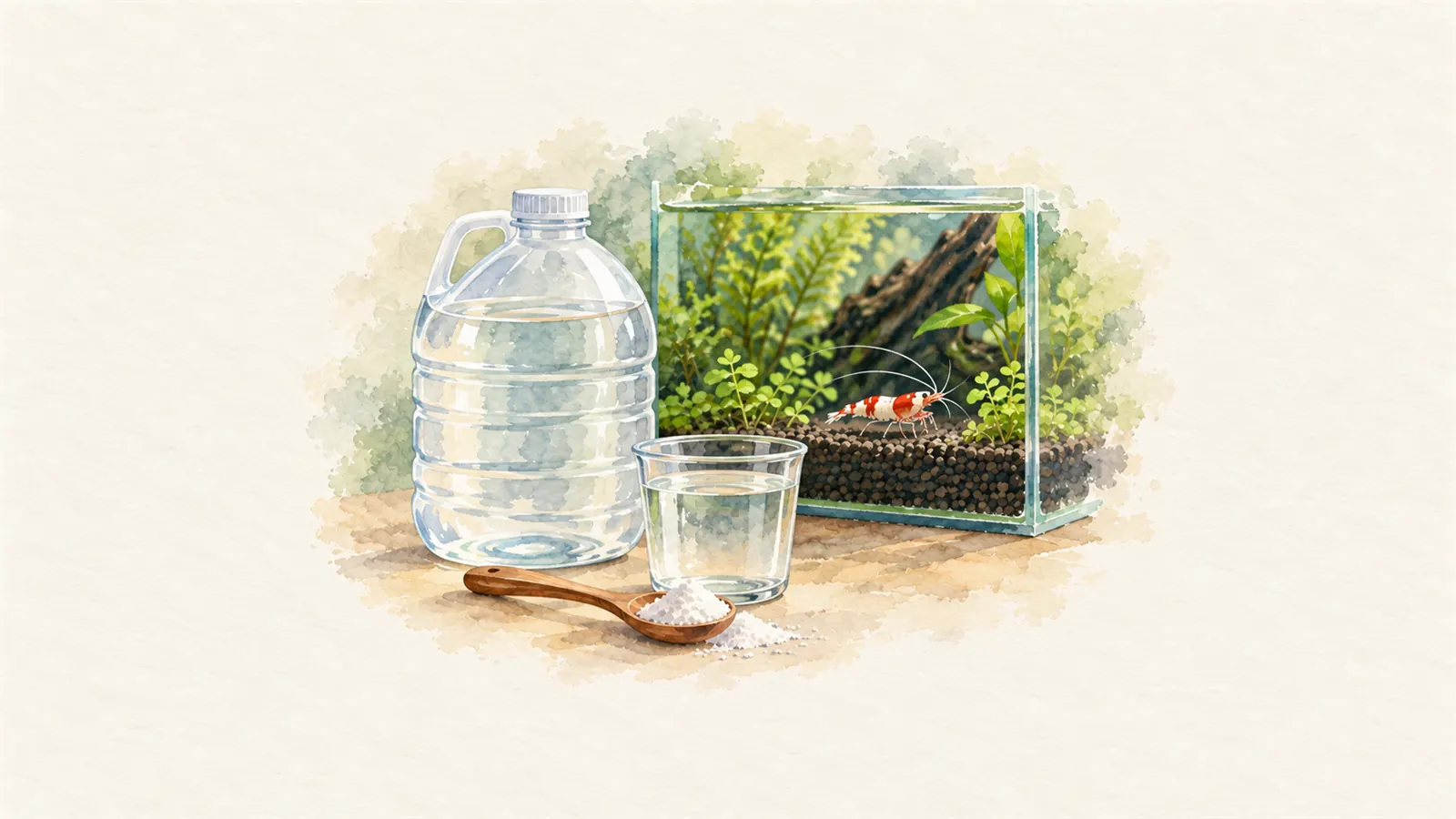
RO (reverse osmosis) water is water with almost all minerals removed and a TDS close to zero. It is the foundation of ideal water for Caridina such as Crystal Red, because you set the hardness and TDS yourself from scratch. For cherry shrimp (Neocaridina) it is usually not necessary.
What is RO water and why use it?
RO water is water pushed under pressure through a membrane with extremely fine pores. The process removes most dissolved minerals, salts and many contaminants, leaving almost pure water, usually with a TDS of 0–10 ppm. It can be made with a home RO unit; distilled water can be used in a similar way.
Its advantage in the shrimp hobby is a known starting point. Tap water varies from place to place and from season to season, while Caridina want soft, stable water. RO water removes that uncertainty.
Why RO water never goes into the tank on its own
Pure RO water is not suitable for shrimp. It lacks the calcium and magnesium they need to build their shells, and the big difference between the shrimp's body and the water causes serious stress. That is why RO water is used after preparing it with a shrimp remineralizer. For Caridina, minerals that raise only GH and keep KH close to zero are usually preferred.
How to prepare RO water for Caridina
- Put the RO water in a clean container and measure its TDS; it should be around 0–10 ppm.
- Add the shrimp mineral according to the product's own instructions, a little at a time, and stir well.
- Wait a few minutes and measure the TDS; keep making small additions until you approach your target. If you overshoot, the only fix is diluting with more RO water.
- Letting the water stand for a few hours and stirring helps the mineral dissolve completely.
- Bring the water to tank temperature before the water change.
If you prepare it the same way every time, you will soon know how many ppm each scoop gives you. We explain how to use a TDS meter in the TDS meter guide.
Target values for Caridina
- GH: 4–6 °dH
- KH: 0–1 °dH
- TDS: usually 120–160 ppm (100–200 ppm is acceptable)
- pH: 5.8–6.8 (usually provided by active substrate)
- Temperature: 20–24 °C (68–75 °F)
These values are not strict rules; what matters most is that they stay stable. In Caridina tanks, swings in GH and TDS are among the most common causes of molting problems. Details in the Caridina care guide.
How it works with active substrate
Caridina tanks usually use active substrate. It lowers the water's KH and holds pH at the slightly acidic level Caridina like. This buffering works best together with RO water that has a KH near zero; with hard, high-KH water the substrate is exhausted much faster.
New active substrate can release ammonia in the first weeks, which is why waiting for the cycle to finish is especially important in a Caridina tank. The buffering effect fades over time; in many tanks the substrate needs replacing within 1–2 years. A slow rise in pH is the sign.
Do cherry shrimp (Neocaridina) need RO water?
Usually not. Cherry shrimp are comfortable at GH 6–10 and pH 6.5–8.0, and in many areas tap water falls within that range. Always treat tap water with a dechlorinator (water conditioner); letting water stand removes some chlorine but not the chloramine used in many cities.
RO water makes sense for Neocaridina if your tap water is very hard, if its values change a lot with the seasons or if you are unsure of its quality. In that case you can reach the target range by mixing RO water with tap water or by preparing it with a mineral made for Neocaridina (one that raises both GH and KH). For general care, see the cherry shrimp and Neocaridina care guide.
Common mistakes with RO water
- Adding RO water to the tank without remineralizing it.
- Adding too much mineral at once.
- Watching only TDS and never measuring GH.
- Topping off evaporation with remineralized water: minerals stay in the tank when water evaporates. Evaporated water should be replaced with plain RO water, otherwise TDS keeps creeping up.
- Making large, sudden water changes.
The values and advice in this guide reflect what is widely accepted in the shrimp hobby. They can vary with the line, your water and the breeder your shrimp came from. Make changes to your tank in small steps.