Neocaridina Color Varieties: From Cherry Shrimp to Blue Dream
Red, blue, yellow, orange, green, black: almost every colorful Neocaridina you see in an aquarium is the same species, Neocaridina davidi. This guide covers the best-known color lines, what the names really mean, why colors mix and what it takes to keep a color stable across generations.
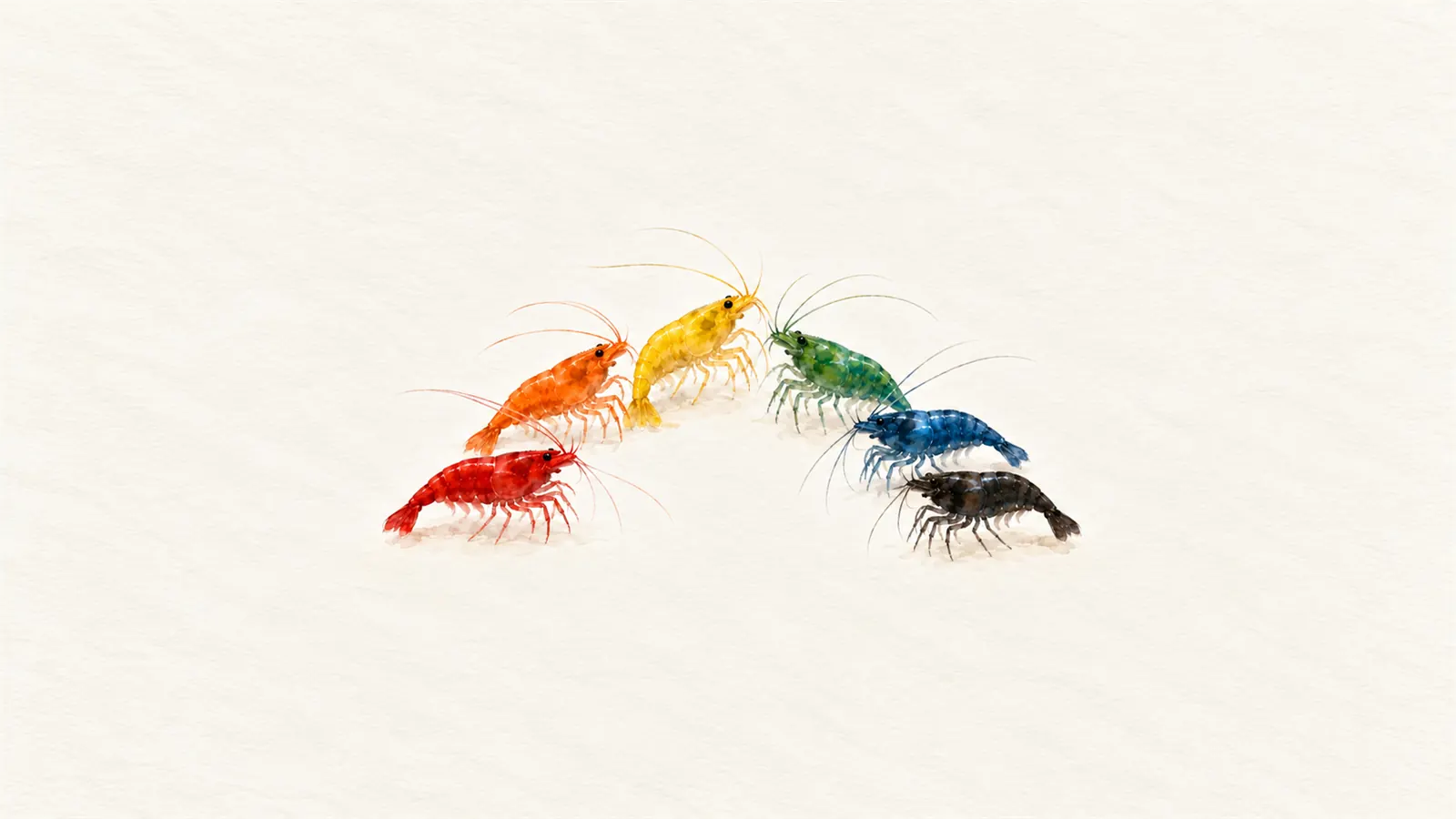
One species, dozens of colors
In the wild, Neocaridina davidi is a brownish, see-through shrimp nobody would look at twice. Today's bright colors come from breeders picking the most colorful individuals and pairing them over many generations, in other words selective breeding. That is why the colors are not separate species but different color lines of one species.
Color does not behave like a single fixed trait; even babies from the same line come out in different shades. This is where "grades" come from: a ranking within a line based on color intensity and how evenly it covers the body. So the difference between Sakura and Fire Red is not species but the color quality of individuals selected from the same line.
Why the names get confusing
Hobby names are not standardized. The same shrimp may be sold under different names by different sellers; what one calls "Blue Diamond" might appear elsewhere as a dark Blue Dream. Photos and where the shrimp came from are more reliable than the name.
Red lines
- Cherry (Red Cherry): light to medium red with see-through patches. "Cherry shrimp" is also used as an umbrella term for all reds.
- Sakura: deeper red that covers more of the body.
- Fire Red: almost fully opaque, deep red.
- Painted Fire Red: no transparency at all; the darkest, most solid red.
- Bloody Mary: a separate red line whose color sits in the tissue rather than the shell, giving a glassy, bright deep red. Kept with Fire Red, the two lines will mix.
Reds are the oldest and most widespread lines in the hobby. Even so, top grades like Painted Fire Red take serious culling and patience.
Blue lines
- Blue Dream: deep, opaque blue and the most popular blue line.
- Blue Velvet: lighter, brighter blue.
- Blue Jelly: a bluish tint over a see-through body.
- Blue Diamond, Sky Blue: other names used by different breeders and sellers.
Blue lines can be less color-stable than reds, with more pale or off-color babies. Breeders' experiences differ here, so the best approach is to watch the colony you buy over a few generations.
Yellows and oranges
- Yellow / Golden Back Yellow: bright yellow; Golden Back has a golden stripe along the back.
- Orange Sakura / Orange Pumpkin: vivid orange.
Yellow and orange lines also need regular selection to stay intense and solid; if you never remove the pale ones, the colony fades over time.
Greens, blacks and browns
- Green Jade: dark green. Green lines are harder to find.
- Black Rose: deep black that can look brownish under some lighting.
- Chocolate: dark brown; it also turns up in mixed-color colonies.
Names for blacks and browns vary between sellers; with these lines, photos and information about the parent colony tell you more than the name.
Patterned and specialty lines
- Rili: a pattern with a see-through middle and a colored head and tail. It comes in several colors, such as Red Rili, Blue Rili and Orange Rili. Rili is a pattern, not a color.
- Snowball: whitish and semi-transparent, named after its white eggs. Some sources list it as a Neocaridina davidi color, others as a closely related species, so opinions differ on whether it interbreeds with other colors. A separate tank is the safe choice.
Color lines at a glance
| Line | Appearance | Note |
|---|---|---|
| Red Cherry | Light to medium red with see-through areas | One of the easiest lines for beginners |
| Sakura | Deep red covering more of the body | Higher grades need culling |
| Fire Red / Painted | Opaque, deep red | Top grades take time and patience |
| Bloody Mary | Glassy, bright deep red | A separate red line |
| Blue Dream | Deep, opaque blue | Pale babies are more common |
| Blue Velvet / Blue Jelly | Light blue / see-through blue | Names vary by seller |
| Yellow / Golden Back | Bright yellow / with a back stripe | Selection is essential for solid color |
| Orange Sakura / Pumpkin | Vivid orange | Shade varies by colony |
| Green Jade | Dark green | Harder to find |
| Black Rose / Chocolate | Blackish / dark brown | Names vary by seller |
| Rili | See-through middle, colored ends | A pattern found in several colors |
| Snowball | Whitish, semi-transparent | Classification differs between sources |
Do different colors mix in the same tank?
Yes. All Neocaridina davidi colors interbreed. Keep red, blue and yellow together and within a few generations most babies will be brown, pale or mixed: they revert toward the wild form. To keep a color, give each line its own tank. Mixing colors only makes sense if you just want healthy shrimp and do not mind the color.
Neocaridina and Caridina (Crystal Red, Taiwan Bee) belong to different genera and do not interbreed, but their water needs differ, so keeping them together is not recommended.
Keeping a color, step by step
- One line per tank: plan a separate tank for each color you want to keep. This is the basic rule.
- Choose your source: buy from a breeder who shares real photos and can show the parent colony. Trust the shrimp you can see, not the name.
- Quarantine: keep newcomers in a separate tank for a while; it cuts both disease risk and the risk of unwanted color mixing.
- Start with enough shrimp: ideally at least 10–15. In very small colonies, inbreeding speeds up.
- Select: move weak-colored, pale or poorly patterned individuals out of the main tank into a separate one.
- Keep records: which line is in which tank, when you added new shrimp and which you removed. Even simple notes help.
- Keep the water stable: for Neocaridina, pH 6.5–8.0, GH 6–10, KH 2–6 and 20–25 °C (68–77 °F) are the commonly accepted ranges. What matters is that values do not swing. See our water parameters guide.
- Vary the diet: foods with carotenoids (spirulina, astaxanthin) support color but will not work miracles on their own.
- Be careful adding new blood: shrimp sold under the same name may be a different line. Check how closely a newcomer matches your colony's color first.
- Be patient: a solid color line takes many generations of selection. Do not expect every baby to be ideal.
Why has my shrimp lost its color?
| Symptom | Possible cause | Check first |
|---|---|---|
| The whole colony suddenly pale and sluggish | Sudden water change, stress, drifting parameters | pH, GH, KH, temperature, ammonia and nitrite |
| New arrivals look pale | Transport and acclimation stress | Dim the light and leave them alone for a few days |
| Pale on a light substrate | Shrimp adjust their tone to the background | A dark substrate, moss and plants |
| Pale right after a molt | The new shell has not hardened yet | Wait 1–2 days; it usually corrects itself |
| Good parents, pale babies | Genetic variation | A selection and culling plan |
| Permanent fading in adults | Genetics, age or line quality | Selection; separate older individuals |
Stress-related fading usually recovers within a few days. Color loss that continues across generations is genetic and only selection fixes it. If sudden fading comes with loss of appetite or deaths, check your water first; color is secondary.
Common mistakes
- Mixing colors in one tank: it looks nice at first, but within a few generations the colony turns brown.
- Buying by name: the same name can mean different lines; photos and source matter more.
- Skipping quarantine: newcomers can bring disease or unwanted colors.
- Using products with copper: shrimp are very sensitive to copper; never use a product if you do not know what is in it.
- Sudden water changes: large changes can disrupt molting; small, regular ones are safer.
- Overfeeding: leftover food degrades water quality.
- Expecting miracles from "color food": diet helps, but it does not replace genetics and selection.
Tips for beginners and experienced keepers
If you are just starting
- Pick a single line; common lines such as Red Cherry or Yellow are good first choices.
- Cycle the tank before buying shrimp; no livestock until the cycle is complete.
- A dark substrate and plenty of plants bring out color and help shrimp feel safe.
- If you keep them with fish, accept from the start that some babies will be eaten.
If you are experienced
- Keep each line in its own tank with its own records.
- Set up a separate tank for low-grade individuals so they do not mix back into the main line.
- When adding new blood, stay within the same line; a similar name is not enough.
- Track shell health, behavior and breeding consistency as well as color.
Frequently asked questions
Can cherry shrimp and Blue Dream live in the same tank?
They can, and they will interbreed. Within a few generations most babies will be brown or mixed. To keep both colors, use separate tanks.
Why do Neocaridina colors turn brown?
All the colors are lines of the same species and interbreed freely. In mixed colonies, reverting to the wild brown, see-through form is the natural result. Keeping a single line and culling prevents it.
My shrimp lost their color. Will it come back?
If the cause is stress, transport, a light substrate or a molt, it usually returns within a few days. If fading continues across generations, it is genetic and only selection will fix it.
Can Caridina and Neocaridina share a tank?
They will not interbreed because they are different genera, but their water needs differ: Caridina want softer, more acidic water, while Neocaridina tolerate a wider range. Separate tanks are healthier.
Does color-enhancing food really work?
Foods with carotenoids can support color, but they do not replace genetics and selection. Food helps a good line reach its potential.
The values and advice in this guide reflect what is widely accepted in the shrimp hobby. They can vary with the line, your water and the breeder your shrimp came from. Make changes to your tank in small steps.