How to Breed Cherry Shrimp: Growing a Healthy Colony
Cherry shrimp (Red Cherry) are among the easiest shrimp to breed. In the right conditions they multiply with very little help from you. Even so, "why aren't my shrimp breeding?" is one of the most common questions in the hobby. This guide covers the breeding cycle, telling males from females, how to grow your colony and the usual mistakes, step by step.
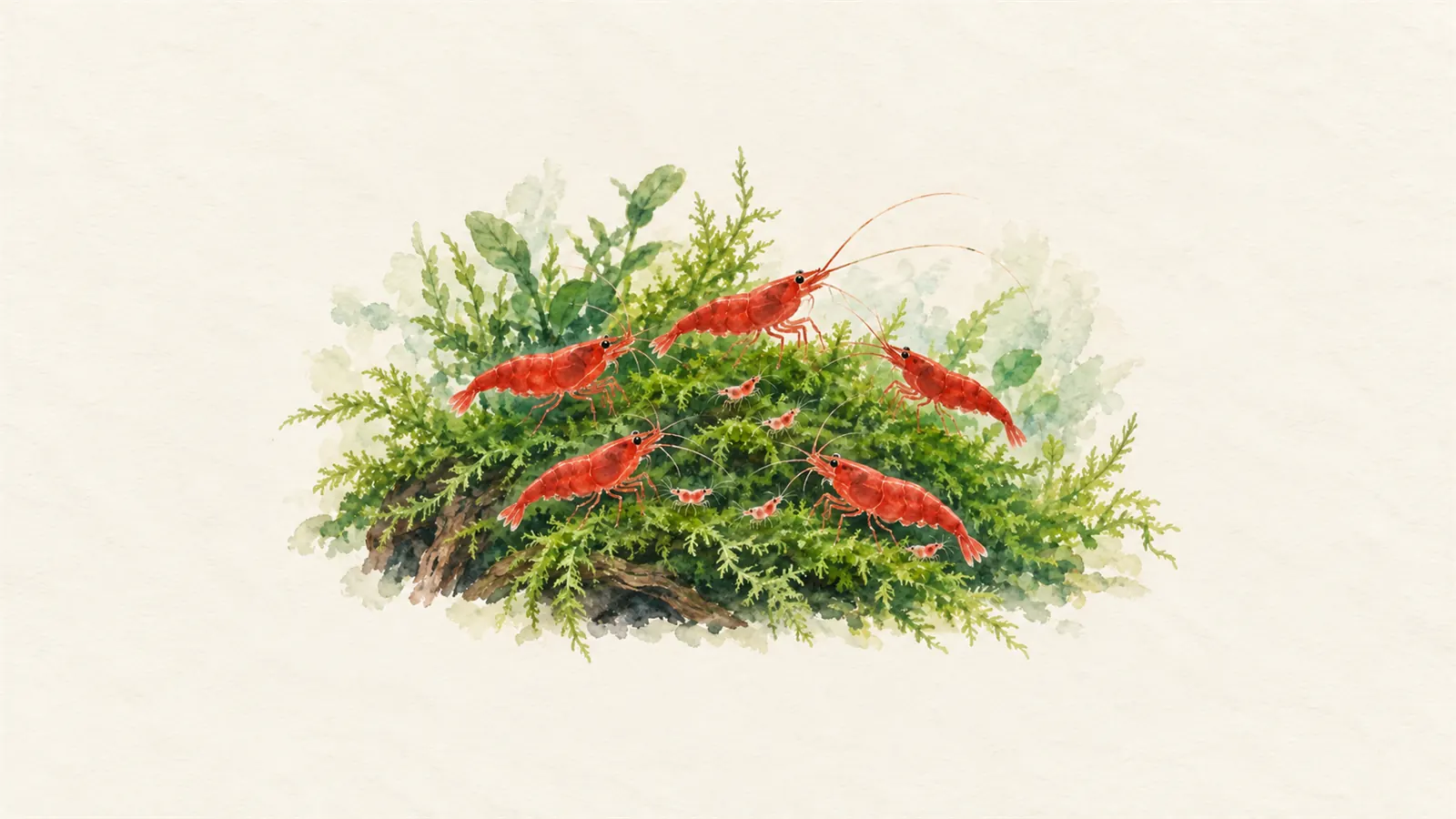
In short: at least 10 shrimp; a cycled tank of 20 liters (about 5 US gallons) or more; 22–25 °C (72–77 °F); a sponge filter; ideally no fish. A colony usually takes 2–3 months to settle in.
A breeding-ready tank: the basics
You do not need a fancy tank to breed cherry shrimp, but you do need stability. In a new tank whose cycle is not fully established, wait for the water to settle before expecting babies. The ranges below are commonly accepted in the hobby.
| Value | Target | Why it matters |
|---|---|---|
| Tank volume | 20 liters (about 5 US gal) and up | Values change more slowly and the colony has room to hide. |
| Temperature | 22–25 °C (72–77 °F) | Below 20 °C (68 °F) breeding slows or stops; sudden swings cause stress. |
| pH | 6.5–8.0 | Extreme values make molting and raising young harder. |
| GH | 6–10 | Very soft water (GH below 4) makes molting difficult. |
| KH | 2–6 | Buffers pH; with very low KH, pH can swing. |
| Nitrate | Below 20 mg/L | High nitrate can make females drop their eggs. |
| Ammonia and nitrite | 0 | Toxic to shrimp. |
| TDS | 150–250 ppm | Avoiding sudden TDS changes matters more than the exact value. |
A sponge filter is the safest option: it will not suck in babies and gives biofilm a surface to grow on. If you use another filter, put a sponge over the intake. Keep water changes small and regular; changing a large share of the water at once can upset berried females.
How to tell male and female cherry shrimp apart
Sexing is the first thing to check in a colony that is not breeding. In adults the difference is fairly clear; with babies and juveniles you need to wait a few weeks.
| Feature | Female | Male |
|---|---|---|
| Size | Usually 2.5–3 cm (about 1–1.2 in) | About 2 cm (about 0.8 in) |
| Body | Fuller; rounded, deeper underside | Slimmer; straight belly line |
| Color | Deeper and more solid | Usually paler or more transparent |
| Saddle | Adult females show a yellowish saddle on the back | No saddle |
Babies and juveniles are hard to sex, which is why buying at least 10 shrimp almost guarantees you have both. If all your shrimp look like the same sex, add a few adults from another group.
How cherry shrimp breed, step by step
- Saddle: a yellowish patch appears on an adult female's back, just behind the head. These are eggs developing in her ovaries.
- Molt: the female molts shortly afterwards.
- Pheromones: right after molting she releases pheromones into the water; the males start searching for her and the tank shows a short burst of activity.
- Mating: mating takes a few seconds.
- Carrying eggs: the female moves the eggs under her tail and carries them for 3–4 weeks, fanning them constantly.
- Hatching: tiny shrimp hatch straight from the eggs; there is no larval stage.
- A new cycle: the female can carry eggs again soon after. The babies mature in about 3–4 months.
For more on how long the eggs take, see our berried shrimp guide.
How many babies does one female have?
A female produces 20–30 babies on average each time; young females have fewer and large ones close to 50. Since she can carry eggs again soon after, a colony that starts with 10 shrimp can reach hundreds within a year. That is a theoretical number, though: food, hiding places, water quality and predators decide the real result.
Why aren't my shrimp breeding? A checklist
Go through the table in order. Usually the problem is not one big mistake but several small sources of stress together.
| Symptom | Possible cause | What to do |
|---|---|---|
| No saddles at all | Shrimp are still young, or the group is mostly male | Wait a few months; check the sexes. |
| Saddles but no eggs | There may be no male in the tank | Add an adult male. |
| Eggs disappear | Stress, high nitrate, a sudden water change | Test your water; make small, regular changes. |
| No babies to be seen | Fish or an open filter intake | Separate the fish; use a sponge filter or cover the intake. |
| Breeding stopped | Temperature below 20 °C (68 °F) | Keep the temperature steady at 22–25 °C (72–77 °F). |
| Deaths during molting | GH too low or unstable values | Test GH and bring it slowly into range. |
| Babies are there but you cannot see them | They hide in moss for the first weeks | Look with a flashlight at night; do not disturb the tank. |
Compare your numbers with our water parameters table; even when values look right, sudden changes can stop breeding. For tiny babies, almost every fish is a threat.
Common mistakes and how to avoid them
- Adding shrimp to an uncycled tank: as ammonia and nitrite rise, shrimp get stressed and stop breeding. See the tank cycling guide.
- Overfeeding: it raises nitrate and feeds pests such as planaria and hydra. Feed lightly and regularly.
- Large water changes: small, regular changes are safer for berried females.
- Never testing GH: very soft water makes molting difficult.
- Keeping different colors together: over generations the colors revert to brown. If color matters to you, keep separate colonies.
- Expecting babies in a tank with fish: fish eat them. A breeding tank is best without fish.
- Constantly disturbing the tank: frequent rescaping and hands in the water cause stress. Leave the tank alone until the colony settles.
How to grow your colony faster
- Add dense moss (Java moss, Christmas moss); it gives babies cover and biofilm.
- Add a few dried leaves for more biofilm, without overdoing it.
- Avoid overfeeding; planaria and hydra prey on babies.
- Keep water changes small and regular.
- Keep the temperature steady around 22–25 °C (72–77 °F).
- If the colony will stay closed for years, add a few shrimp from a trusted source now and then to keep genetic diversity; quarantine newcomers in a separate tank first.
Tips for beginners and experienced keepers
If you are just starting
- Focus on stability, not fancy decor, in your first tank.
- Start with at least 10 shrimp to avoid ending up with only one sex.
- Test your water weekly, especially GH and nitrate.
- Drip acclimate new shrimp slowly.
If you are experienced
- To protect a color line, keep your selection tank separate from your breeding tank.
- Keep each color line in its own tank.
- Watch colony size; in an overcrowded tank, balancing food and water quality gets harder.
Selecting for color
As the colony grows you will see that some babies are paler and some darker. To keep and improve the color, leave the darkest shrimp in the breeding tank and move the pale ones out. This is called selective breeding or culling.
Frequently asked questions
How long does it take cherry shrimp to breed?
A female usually carries eggs for 3–4 weeks; temperature, water values and her age affect the time. After the babies hatch, she can carry eggs again quite soon.
How many babies does one female have?
20–30 on average. Young females have fewer; large adults can have close to 50.
Why aren't my shrimp carrying eggs?
The most common reasons are no male in the tank, shrimp that are still young, low temperature or unstable water. If you see saddles but no eggs, first check that you have a male.
How do I recognize a male?
Males are usually smaller, slimmer and paler, with a straight belly line and no saddle.
Should I move the babies to another tank?
There is no need. In a fish-free tank with dense moss, babies grow up on their own; adult cherry shrimp do not harm them. If there are fish in the tank, a separate tank for the babies is safer.
What happens if I keep different colors together?
Over generations the colors mix and mostly revert to brown. To keep a color line, breed each color in its own tank. See Neocaridina colors.
The values and advice in this guide reflect what is widely accepted in the shrimp hobby. They can vary with the line, your water and the breeder your shrimp came from. Make changes to your tank in small steps.