How to Selectively Breed Shrimp
What makes a line beautiful is not luck but patient, consistent selection. Selective breeding means letting the best individuals breed and separating those with traits you do not want, moving your line in the direction you want over generations. In this guide you will find what separates selection from random culling, how to set up your tanks and how to keep a record of your decisions.
Why is selection necessary?
Shrimp babies are not exact copies of their parents. Even the best shrimp produce mixed offspring; bright, pale, patterned and near-wild individuals can appear in the same batch. In a colony where nobody selects, colors and patterns decline over time, because pale and wild-type individuals breed too and their traits spread further with every generation.
Selection is not "getting rid of bad shrimp"; it is deciding which individual lives in which tank. The shrimp you separate are living animals too and need care. Done right, selection makes your line more predictable while protecting the health of the colony.
Set your goal first
Focusing on one or two traits gives faster results. If you try to fix color intensity, pattern, leg color and body shape all at once, it becomes hard to track which individual carries which trait. Write your goal down, for example "deep red covering the whole body, little transparency, red legs too".
In Neocaridina (cherry, Fire Red, Blue Dream, rili lines etc.), color intensity, how much of the body and legs it covers, and how little transparency there is come first. In Crystal and Bee lines, the proportion, thickness and opacity of the white and the cleanness and symmetry of the pattern decide. Grading systems vary between breeders and regions, so trust your own observation and consistent criteria rather than the label alone. For details, see the grading system and Neocaridina colors guides.
Set up your selection tanks
Selection needs at least two tanks: a keeper tank and a cull tank. Only the individuals closest to your goal stay in the keeper tank, and breeding happens there. Individuals outside your goal go to the cull tank. The cull tank is not a "bad tank"; the shrimp there can be sold as a lower grade, traded or given away. Stating the grade honestly in a listing protects both the buyer and trust in the hobby.
Avoid sudden temperature and water value swings in both tanks. A sponge filter, moss, leaves and biofilm give shrimp both hiding places and food. Strong current and aggressive tank mates cause stress, and stressed shrimp look pale, which misleads your judgment. Keep temperature, pH and GH stable within the right range for your species; Neocaridina and Caridina tolerate different ranges.
Judging shrimp correctly, step by step
The most critical part of selection is judging a shrimp at the right moment and under the right conditions. Follow this order:
- Catch the shrimp without chasing it, with a wide net; keep stress low.
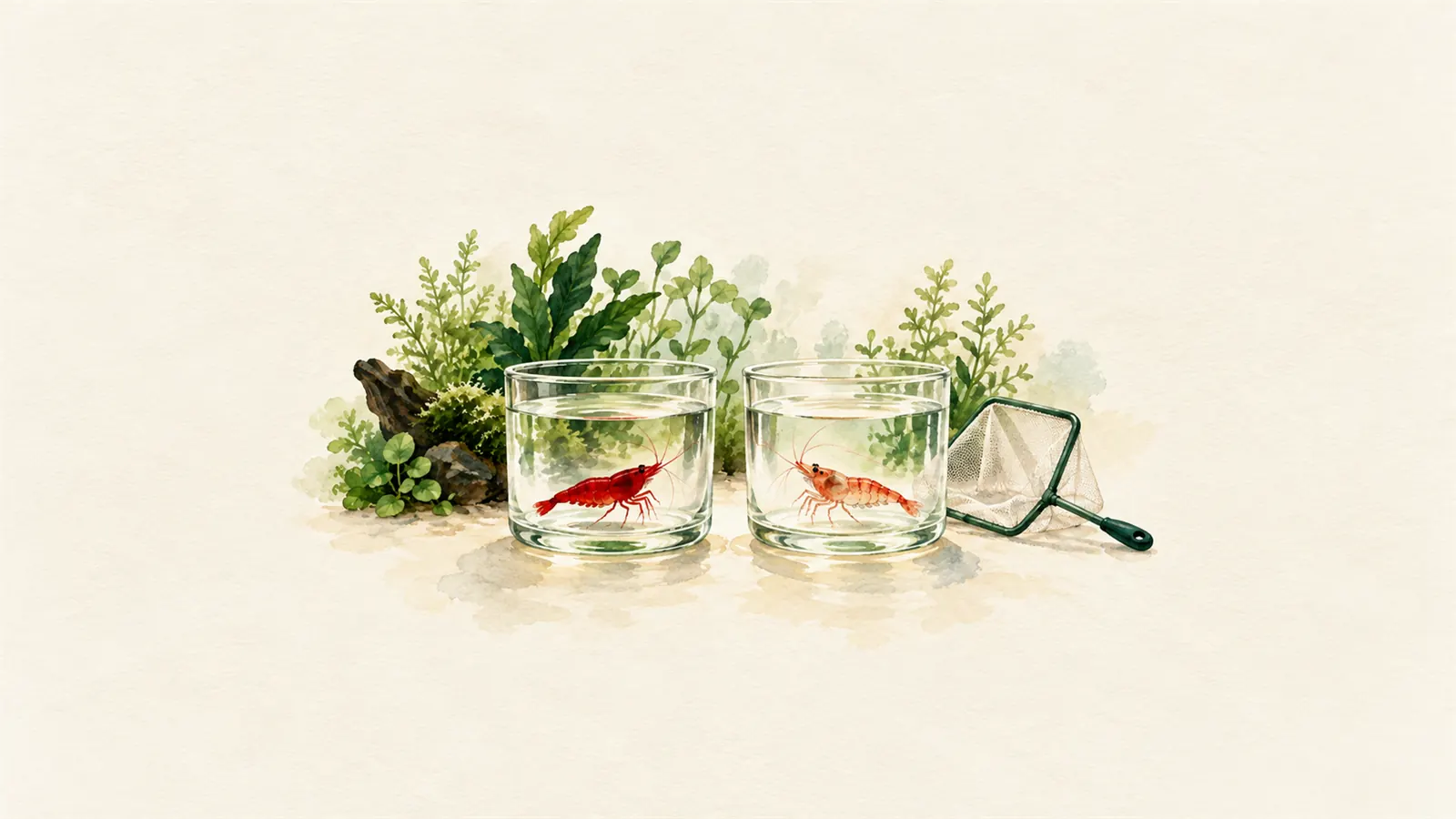
- Put it in a small white container filled with tank water. A white background shows color and pattern more clearly.
- Judge under the same light every time. Different light can make the same shrimp look different.
- Look from above and from the side; only then can you see color intensity and pattern symmetry.
- Compare with individuals of the same age and sex. Putting a young and an old shrimp side by side is misleading.
- Do not keep shrimp in the container for long; the water temperature should not change. A few minutes is enough.
- After judging, quickly return the shrimp to the tank it belongs in and record your decision right away.
Timing and age
Young shrimp's colors become clearer as they grow. Culling too early can make you miss individuals that would have become beautiful. Try to catch the period when color and pattern have become clear but the shrimp is still young. In Neocaridina males are usually paler than females, so compare males among themselves. A shrimp can look pale temporarily because of molting or stress; do not decide from a single look, watch for a few days.
Tell males and females apart
Females are usually larger and more colorful, with a rounder underside; females ready to breed show a saddle. Males are slimmer, smaller and often paler. Your keeper tank needs both good females and good males. Selecting only females and neglecting males limits the line's color potential; half of the babies' genes come from the male.
Remove throwbacks right away
Move brown, transparent or very pale babies that have reverted toward the wild form out of the keeper tank right away. If individuals with a broken, asymmetric pattern or colorless legs are outside your goal, move them to the cull tank too. Leaving them in the keeper tank speeds up color decline in the next generation. Do the separating calmly but decisively.
Keep records
Note which individuals you paired, when the babies hatched and the quality spread. Writing down a batch as "3 good, 5 average, 12 weak" by your own criteria makes progress easy to measure. A simple notebook or spreadsheet is enough. Photos taken under the same light are the most reliable way to compare color and pattern changes a few generations later. Keeping records turns selection from guesswork into a manageable process.
Common mistakes and how to avoid them
- Culling too early: do not decide before color has settled; watch young individuals for a while.
- Focusing only on females: judge males among themselves too, and keep good males in the keeper tank.
- Mixing different lines in one tank: Neocaridina colors interbreed; the mix usually produces brownish babies and sets selection back.
- Neglecting the cull tank: the shrimp there need regular water changes, filtration and food too.
- Judging under different lights: always use the same light and a white background.
- Not keeping records: without knowing which pairing produced what, progress cannot be measured.
- Selling a low grade as high: give honest grade information; it protects your reputation in the hobby.
- Using medications and chemicals unnecessarily: many medications are risky for shrimp; avoid anything containing copper entirely, and if in doubt, do not use it.
Selection priorities in Neocaridina and Caridina
| Trait | Neocaridina (cherry etc.) | Caridina (Crystal / Bee) |
|---|---|---|
| Main goal | Color intensity and body coverage | Proportion, opacity and pattern symmetry of the white |
| Judging color | Little transparency, leg color | Thickness and cleanness of the white |
| Pattern | Mostly solid color and coverage | Bands, spots and symmetry decide |
| Sex difference | Males clearly paler | Males smaller, sometimes paler |
| Water conditions | Wide tolerance, stability matters | Narrow tolerance, stability critical |
| Selection priority | Color first, then pattern | Clean pattern and opaque white first |
Tips for beginners and experienced keepers
If you are just starting
Start with a single line and do not mix lines. Note pairings and hatch dates in a simple notebook. In the first generations, only remove individuals that have clearly reverted to the wild form, brown or completely transparent ones. Put colony growth first; in a small colony, heavy culling needlessly reduces the number of breeding shrimp. For breeding basics, see the cherry shrimp breeding guide.
If you are experienced
Build sub-lines, track each in its own tank and take regular photos. When refreshing a line, choose individuals from the same line and of similar quality; observe newcomers in a separate tank for a few weeks. Look at several traits together, not just one. If shrimp health declines, color and pattern suffer too; treat water quality as part of selection.
Be patient and refresh the line
Results show after several generations of consistent selection toward the same goal. Do not expect a miracle from a single batch; selection is about giving direction. In lines bred within themselves for a long time, vitality can decline over time. That is why many breeders now and then add a few individuals of the same line and similar quality from another source to refresh it. Observing newcomers in a separate tank first keeps possible diseases or unwanted traits out of the keeper tank.
Frequently asked questions
How many tanks do I need for selection?
At least two: a keeper tank and a cull tank. Experienced keepers use extra tanks for sub-lines and quarantine. The more tanks, the more work to track them; starting with two tanks is more sustainable.
When should I separate baby shrimp?
Start when color and pattern have become clear but the shrimp is still young. Separating them too small can make you miss individuals that would have become beautiful. Decide after a few days of watching, not a single look.
What should I do with the shrimp I cull?
You can keep them in the cull tank, sell them honestly as a lower grade, trade them or give them away. What matters is that these shrimp live in healthy conditions too and that the grade information is stated clearly.
Males are paler. Should I select them too?
Yes. Good males shape the future of the line. Compare males among themselves, not with females. Your keeper tank should have both good females and good males.
Is refreshing a line necessary?
Not always, but vitality can drop in lines bred closed for a long time. If you refresh, choose individuals from the same line and of similar quality and observe newcomers in a separate tank first.
The values and advice in this guide reflect what is widely accepted in the shrimp hobby. They can vary with the line, your water and the breeder your shrimp came from. Make changes to your tank in small steps.