Shrimp Grading Explained: What Do S, SS and SSS Mean?
Terms you often see in shrimp listings, such as S, SS, SSS or Sakura and Fire Red, are a grading system describing a shrimp's visual quality. Knowing what it measures and what it does not helps you both when buying and when breeding. Reading these letters on their own as a guarantee of a "good shrimp" is one of the most common mistakes in the hobby.
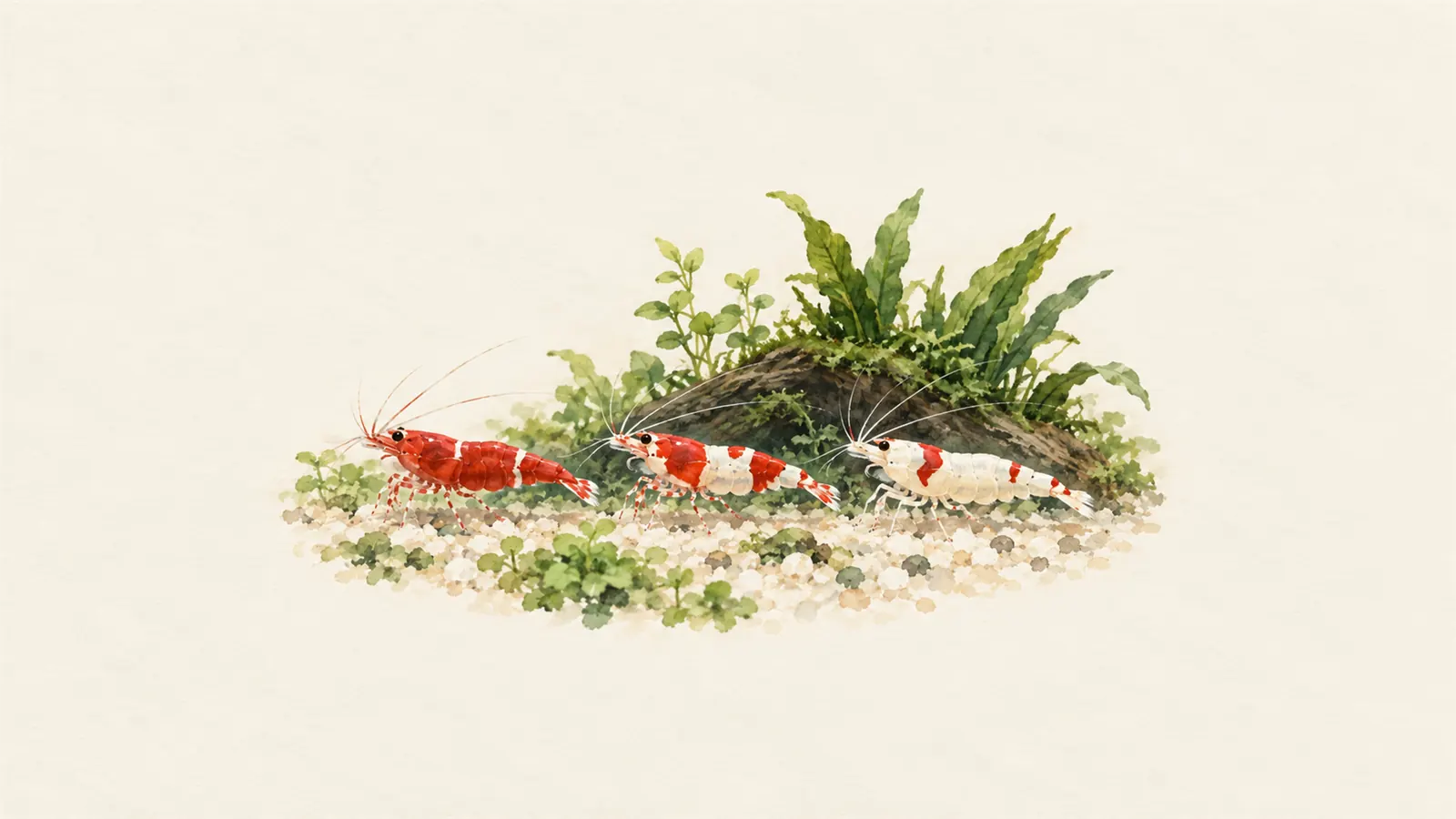
What grading tells you, and what it does not
A grade is a quality classification based on a shrimp's appearance: how intense the color is, how clean the pattern is, how thick and complete the white is. A grade says nothing about the shrimp's health, age or hardiness. A high-grade shrimp is not automatically healthier, longer-lived or easier to breed.
The most important thing to know: there is no universal standard. Grading varies between breeders, between countries and even between listings from the same seller. A shrimp one seller calls SS may look like another seller's S. That is why the shrimp's own photos and video are more reliable than the letters.
A grade also tells you nothing about water parameters, tank conditions, the overall health of the colony or genetic diversity. Two shrimp raised in the same tank can get different grades; that does not mean the tank is bad.
Crystal Red and Crystal Black: from C to SSS
For Crystal Red (CRS) and Crystal Black (CBS), grading is largely based on the proportion of white on the body and how neat the pattern is. The common order from low to high is C, B, A, S, SS and SSS. In C, B and A the body is more clearly colored and the white bands are thin. In S the white areas have widened and the colored bands narrowed. In SS most of the body is white. SSS shows an almost completely solid, opaque white, with only limited colored areas.
Some patterns at the higher grades have their own names. Hinomaru, for example, is commonly used for a white body with a single colored spot on the head, and Mosura for patterns where white dominates and the color stays mostly toward the tail. These names are also interpreted differently by different sellers; do not decide on the name alone without seeing photos.
Not only the amount of white matters but also its quality: a dense, opaque, smooth white is considered more valuable than a pale, semi-transparent one. The symmetry of the pattern and the arrangement of the colored areas also count. But these are all visual criteria; an individual's value as breeding stock is a separate matter.
Neocaridina: from Cherry to Painted
Red Neocaridina are graded with names rather than letters, and the main criteria are color intensity and coverage: Cherry (light, partly transparent red), Sakura (more intense, most of the body colored), Fire Red (fully red body, color on the legs too) and Painted Fire Red (deep, fully opaque red). These names are not universal either; a shrimp that looks the same may be sold as Sakura by one seller and Fire Red by another.
Some red lines such as Bloody Mary are not part of this scale and are considered separate lines. Other colors (blue, yellow, orange) are judged the same way, by color intensity and coverage. Mixing different color lines in one tank scatters the colors in the babies, so knowing which line you keep matters as much as the grade. For colors, see the Neocaridina colors guide.
Grading comparison table
| System | Grade | Short description | Watch out |
|---|---|---|---|
| Crystal Red / Black | C, B, A | Body more clearly colored; thin white bands. | Low grade does not mean unhealthy. |
| Crystal Red / Black | S | White areas widened, colored bands narrowed. | Light and photo angle can make white look like more than it is. |
| Crystal Red / Black | SS | Most of the body is white. | Opacity of the white and pattern layout are judged separately. |
| Crystal Red / Black | SSS | Almost completely solid, opaque white. | The "highest" label can vary by seller. |
| Red Neocaridina | Cherry → Sakura → Fire Red → Painted | Color intensity and coverage increase; Fire Red should show color on the legs too. | Bloody Mary is considered a separate line. |
Steps to judge a shrimp's grade
- Identify the species and line. CRS/CBS, Neocaridina or a separate line like Bloody Mary? Grade names differ from system to system.
- Ask for the seller's own photo or video. Seeing the shrimp actually for sale is more reliable than a grade label.
- Mind the lighting. Strong light and filters can make colors look more intense than they are; a short video is more realistic.
- Judge color intensity and pattern separately. The opacity and symmetry of the white and the layout of colored areas matter as much as its amount.
- Look at the details. For Fire Red and Painted, color on the legs and coverage around the tail are good indicators.
- Ask about age and size. Young shrimp color up as they grow; comparing a juvenile to an adult grade is misleading.
- Check health separately. Activity, a clean shell and appetite should be judged independently of grade.
- Do not add new shrimp straight to the main colony. A short observation period lowers both the disease risk and the risk of mixing lines.
Buying checklist
| Check | What to look at | Why it matters |
|---|---|---|
| Photo / video | The seller's own footage or a stock photo? | Stock photos can be misleading. |
| Lighting | Very bright, filtered or from a single angle? | Color can look more intense than it is. |
| Species / line | CRS, CBS, Neocaridina or a separate line? | Grade names differ between systems. |
| Color / pattern | Intensity, symmetry, opacity of the white. | The amount of white alone is not enough. |
| Age / size | Juvenile or adult? | Color may not have settled yet in young shrimp. |
| Health | Activity, shell, appetite. | A grade is no guarantee of health. |
Common mistakes and how to avoid them
- Confusing grade with health. A high-grade shrimp can be weak; a low-grade shrimp can be very hardy. Judge looks and health separately.
- Deciding from a stock photo. Ask for a photo or video of the actual shrimp for sale.
- Ignoring lighting and filters. The same shrimp can look completely different under different light.
- Taking a young shrimp's color as final. Wait until the color settles.
- Looking only at the amount of white. The opacity of the white and the pattern layout matter at least as much.
- Mixing different color lines. In Neocaridina, different colors interbreeding in one tank scatter the colors of the babies.
Do high-grade parents always produce high-grade babies?
No. The babies of two high-grade shrimp are usually mixed: some as good as the parents, some lower, and occasionally a few better. That is because individuals that look alike can carry different genetics. Raising and keeping a line's quality comes from choosing the right individuals over generations, which is called selective breeding. That is why choosing breeding stock matters more than buying a single "perfect" shrimp.
Tips for beginners and experienced keepers
If you are just starting
Learn your species and line first, and keep in mind that CRS/CBS and Neocaridina use different grading systems. Do not make SSS or Painted your first goal; aim for a healthy, active, well-fed colony. Ask for the seller's own photos when buying and do not mix different colors in one tank. See a grade label as a starting point, not as the only basis for a decision.
If you are experienced
Keep lines separate, keep records and pair your chosen individuals deliberately. Watch the colony's vitality, molting and breeding consistency as well as appearance. Be careful not to narrow a line too much over the long term; when needed, work with compatible new individuals in a planned way. Treat grade not as a goal but as the visible result of the selection process.
Frequently asked questions
What is the difference between S, SS and SSS?
In CRS/CBS, white areas widen in S, most of the body is white in SS, and an almost completely solid, opaque white is expected in SSS. These thresholds are not universal; sellers may call the same shrimp by different grades.
Are high-grade shrimp hardier?
No. A grade only describes appearance; it says nothing about health, age or hardiness.
Are Sakura and Fire Red the same?
No. In Sakura the red is more intense, but the whole body may not be covered. Fire Red should be fully red, with color on the legs too. Painted Fire Red stands out with an even deeper, opaque red.
Why does the same grade look different in different listings?
Because there is no shared standard. Lighting, filters, photo angle, the shrimp's age and the seller's interpretation all change the result. Look at the shrimp's own photos and video more than the letters.
What is the most important step to raise grades?
First build a healthy, stable colony; then pair the individuals closest to the look you want in a planned way. Instead of focusing on one shrimp's grade, aim to raise the line's overall average over a few generations.
The values and advice in this guide reflect what is widely accepted in the shrimp hobby. They can vary with the line, your water and the breeder your shrimp came from. Make changes to your tank in small steps.