Berried Shrimp: How Long Until the Eggs Hatch?
If you have spotted tiny balls under your female shrimp's tail, congratulations: she is berried. This guide explains when the eggs will hatch, what to do (and not do) so you do not stress the female, why shrimp drop their eggs and what happens once the babies arrive.
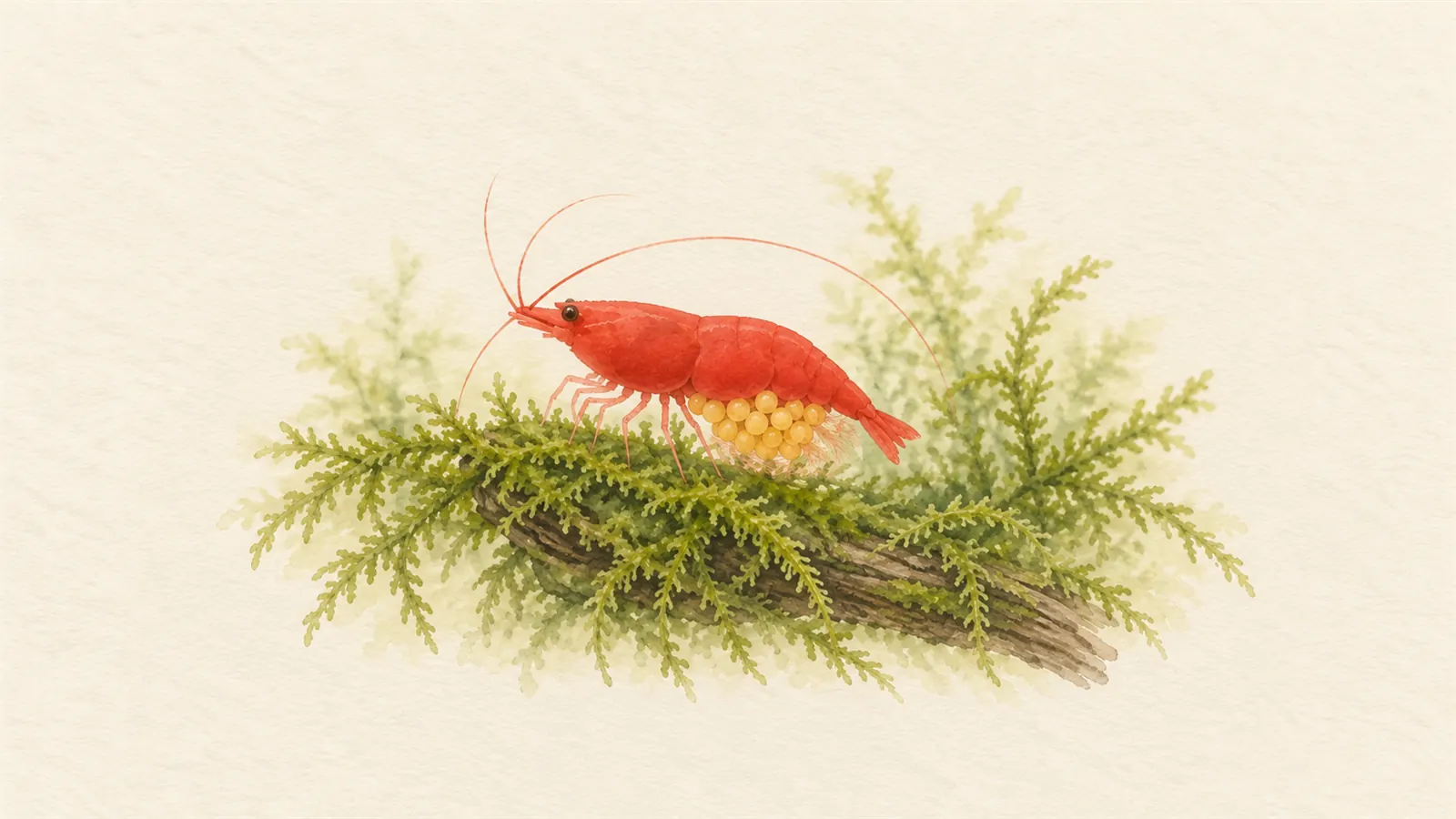
Quick answer: what to expect
Neocaridina egg facts: hatching takes about 3–4 weeks; 20–30 eggs (up to 50 in large females); babies are 1–2 mm; they mature in 3–4 months; there is no larval stage. Timing depends on temperature: warmer water shortens it, cooler water lengthens it.
| Shrimp group | Hatch time | Babies | Note |
|---|---|---|---|
| Neocaridina (Red Cherry, Blue Dream, Yellow, etc.) | 21–30 days | Tiny shrimp, no larval stage | Temperature sets the timing |
| Caridina (Crystal Red, Taiwan Bee) | About 4 weeks | Tiny shrimp, no larval stage | More sensitive to water changes |
| Amano shrimp | Different cycle | Larvae | Larvae need salt water and do not survive in a freshwater tank |
Before the eggs: the saddle and mating
A female ready to breed shows a yellowish, greenish or orange patch on her back, just behind the head. This is called a saddle: eggs developing in her ovaries. A saddled female is ready to mate right after she molts. Around then you may see males swimming around the tank fast and excitedly. Keepers call this the "mating dance"; it is normal, so do not try to catch the female or move her.
Do not confuse a saddle with a berried female. The saddle sits on the back, inside the shell; fertilized eggs are carried under the tail, between the swimmerets (pleopods). While berried, the female may be calmer, shyer and seen less often.
How many days until shrimp eggs hatch?
Neocaridina eggs usually hatch in 21–30 days. Around 24–25 °C (75–77 °F) it is closer to 3 weeks; around 20 °C (68 °F) it can take more than 4 weeks. So watch the range and the eggs themselves rather than counting days.
The eggs change color as they develop. At first they resemble the female's color (yellow, red, green); close to hatching they turn pale and two tiny black dots appear inside each one: the babies' eyes. Once you can see eyes, hatching usually happens within a few days.
Caridina (Crystal Red, Taiwan Bee) take about the same time, roughly 4 weeks. Amano shrimp are completely different: their young hatch as larvae that need salt water.
How many eggs does a female carry?
An average Neocaridina female carries 20–30 eggs. Young, small females may carry fewer than 10, while large adults can approach 50. It is normal for young females with their first clutch to carry fewer eggs and sometimes drop them. Egg count alone does not mean success; what matters is that she fans the eggs regularly and the water stays stable.
Step by step: what to do while she is berried
- Watch, do not intervene. Moving the female to another tank is usually unnecessary, and the stress can make her drop the eggs.
- Keep water changes small. Continue your routine 10–20% changes and avoid large, sudden ones. Add new water at tank temperature.
- Keep values stable. Sudden swings in temperature, pH or hardness are a common cause of dropped eggs.
- Feed normally. You will see her fanning the eggs constantly to keep them oxygenated and clean. Do not flood the tank with food; excess food hurts water quality.
- Make the filter safe. Put a sponge over the intake before the babies hatch.
- Leave hiding places. Moss, leaves and fine twigs help babies hide in their first days; do not strip out moss to make the tank spotless.
- Note the date. Writing down when you first saw her berried makes it easy to estimate the hatch date.
Do not add medications or chemicals during this time. Shrimp are sensitive to many products and anything containing copper can be deadly; if you are not sure, do not use it.
Why do shrimp drop their eggs?
The most common causes of a berried female losing her eggs:
- Stress: transport, being caught with a net, aggressive fish in the tank.
- Sudden water changes: a fast shift in temperature or hardness.
- A young female: common with first clutches, usually better next time.
- Unfertilized eggs: if there is no male or mating did not happen, the eggs drop within a few days.
- Poor water quality: high nitrate, ammonia or nitrite.
An occasional dropped clutch is normal. But if many females keep dropping eggs, test your water. Our water parameters guide can help.
Signs and checklist
| What you see | What it means | What to do |
|---|---|---|
| Yellowish or greenish patch on the back | Saddle; eggs are developing | Keep conditions stable |
| Males swimming fast | Mating dance | Normal; leave them be |
| Eggs under the tail | Berried female | Do not touch or move her; keep changes small |
| Eggs constantly fanned | Oxygen and cleaning | Normal behavior |
| Pale eggs with black dots | Babies' eyes; hatching is near | Check the filter intake |
| An occasional dropped egg | Stress, a young female or unfertilized eggs | If it keeps happening, test the water |
| No babies visible | They hide for the first days | Look among moss and leaves |
After the babies hatch
Neocaridina have no larval stage. The babies hatch at 1–2 mm as miniature copies of their parents and start grazing on day one. For the first few days most of them hide in moss and leaves, so do not worry that they have disappeared.
Do shrimp eat their babies?
No, they do not hunt healthy babies. They may eat a dead one, which is natural. The real dangers are fish and the filter. Always cover the filter intake with a sponge; in a tank with fish, very few babies survive.
How fast do the babies grow?
Well-fed babies reach about 5–6 mm in a month, and their color starts to show. They mature in 3–4 months, when females show their first saddles. Warmer water speeds growth but can shorten lifespan; 22–24 °C (72–75 °F) is a balanced range.
Tips for beginners and experienced keepers
If you are new
The biggest trap is the feeling that you must do something. Moving the berried female to a separate container, chasing her with a net or deep-cleaning the tank usually makes things worse. Instead, check the temperature, the filter intake and keep water changes small. You may lose a clutch on the first try; that is part of learning.
If you are experienced
Records are the most useful thing you can keep now: when you saw the female berried, the temperature range and when the babies first appeared will help you plan future breeding. If you have added new fish, plants or products, watch how berried females react. See the cherry shrimp breeding guide for planning.
Frequently asked questions
Should I move a berried female to a separate tank?
Usually not. Neocaridina babies hatch as tiny shrimp and can grow up in the main tank. Catching and moving the female causes stress and raises the risk of dropped eggs. Only consider a separate tank if there are fish that will eat the babies.
How can I tell the eggs are about to hatch?
Close to hatching the eggs turn pale and two tiny black dots, the babies' eyes, become visible inside. Hatching usually follows within a few days.
Does the female eat her eggs?
She does not eat healthy eggs, but she may clear out unfertilized or dead ones. If you see this often, check water quality, temperature swings and sources of stress.
Why do the eggs turn white and drop?
Unfertilized eggs, a water quality problem, a sudden temperature change or stress. Losing a few eggs now and then is normal; if it happens constantly across many females, test the water first.
When will she be berried again?
After the babies hatch she usually molts and, in good conditions, can carry eggs again soon. The timing depends on her age, food and water; watch for a saddle and a molt.
The values and advice in this guide reflect what is widely accepted in the shrimp hobby. They can vary with the line, your water and the breeder your shrimp came from. Make changes to your tank in small steps.