The 10 Easiest Plants for a Shrimp Tank
In a shrimp tank, plants are not just decoration: they mean hiding places for babies, surfaces for biofilm and more stable water. If you keep cherry shrimp or Crystal Red, you can start with these 10 easy plants that grow in low light and without CO2.
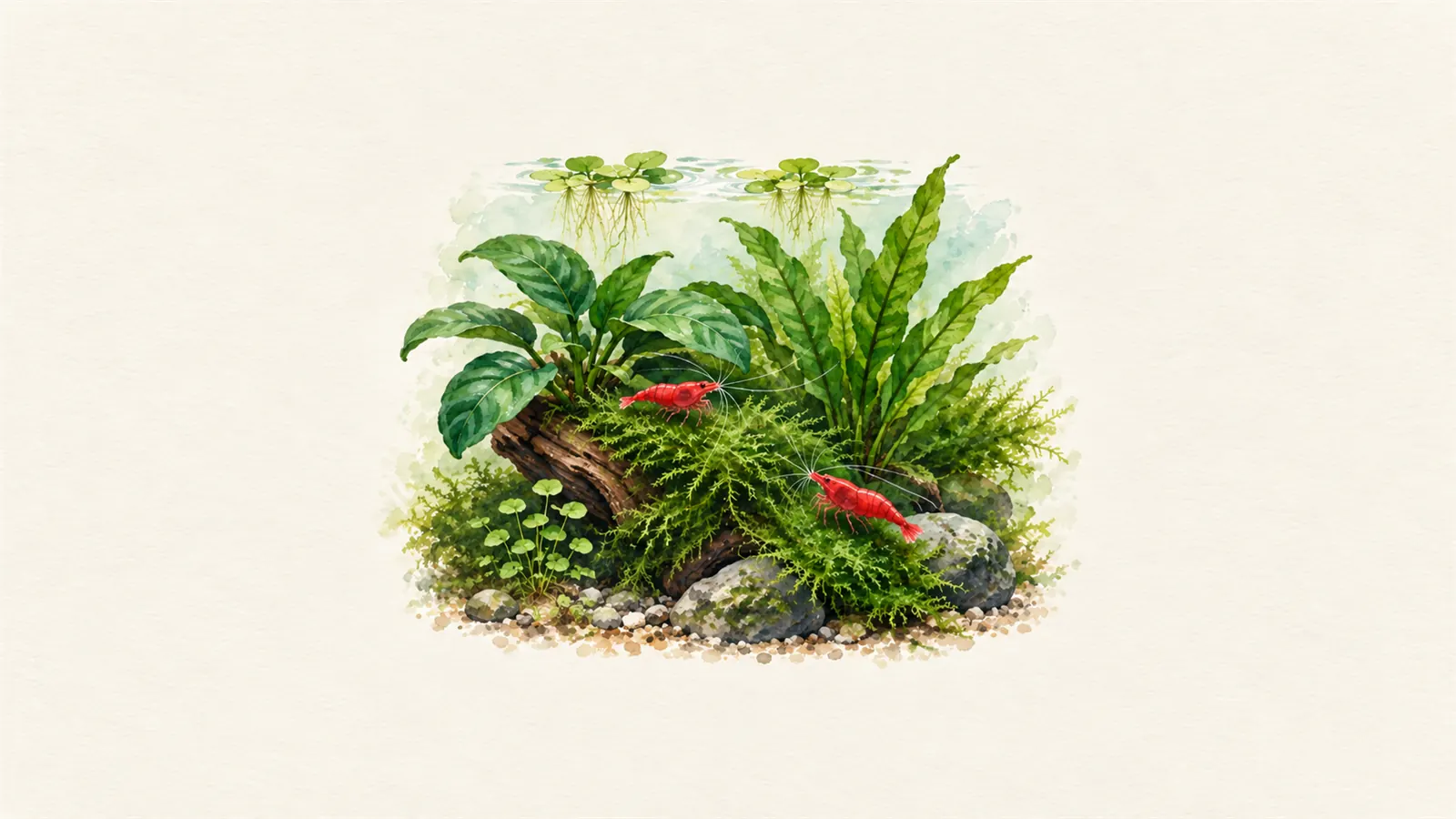
Why put plants in a shrimp tank?
Plants do three jobs in a shrimp tank: they give babies and molting shrimp places to hide, they collect the biofilm shrimp graze on all day, and they use up excess nitrate, which supports water quality. Shrimp can live in a bare tank, but fewer babies usually survive. Mosses in particular are the most valuable plants for shrimplets. For general care, see the cherry shrimp and Neocaridina care guide.
The 10 easiest plants for a shrimp tank
1. Java moss (Taxiphyllum barbieri)
The number one shrimp tank plant. Its dense, branching growth gives babies three-dimensional cover, and biofilm builds up on it quickly. It grows in low light and needs no CO2. Tie it to a stone or a piece of wood. If it gets very dense, the inside can trap dirt; thinning it lightly every few weeks is enough.
2. Christmas moss (Vesicularia montagnei)
Similar to Java moss but tidier, growing in layers that look like little fir trees. It also grows in low light without CO2 and makes excellent cover for babies. It grows a little more slowly than Java moss.
3. Pearl moss
A moss with small, round leaves and a soft, cushion-like look. Instead of spreading, it grows into cushions. It lives in low to medium light and grows slowly. Shrimp love wandering between the cushions.
4. Subwassertang (Lomariopsis lineata)
Technically a liverwort, but it behaves like a moss. Its overlapping, lobed leaves form layered hiding places and collect plenty of biofilm. It grows slowly, needs almost no trimming and is happy in low light. It is also popular in Caridina tanks.
5. Anubias nana
An epiphyte with thick, tough leaves that stays 5–10 cm tall. It lives in low light, needs no CO2 and grows very slowly. Do not bury the rhizome in the substrate; it will rot. Attach it to a stone or wood with fishing line or plant glue. Its broad leaves are both a grazing spot and a resting place for shrimp.
6. Java fern (Microsorum pteropus)
An epiphyte like Anubias: slow-growing, low-maintenance and tolerant of low light. Again, do not bury the rhizome. Its long leaves add nice texture to the back of the tank.
7. Bucephalandra
An epiphyte similar to Anubias but smaller, often with colorful leaves. It grows very slowly, lives in low light and needs no CO2. It is usually more expensive than the others, but it looks great in small tanks.
8. Salvinia
A floating plant with hairy leaves. By partly covering the surface it softens the light, uses excess nitrate, and its hanging roots give babies a place to hide. It grows fast and needs regular thinning. It does not like strong surface current.
9. Red root floater (Phyllanthus fluitans)
A floating plant that is both pretty and useful, with reddish leaves and roots. Shrimp wander among the roots, which hold biofilm. It grows quickly; thin it now and then so it does not cover the whole surface.
10. Duckweed
The easiest floating plant: almost impossible to kill and quick to use up excess nitrate. But it multiplies very fast, can shade the plants below and is hard to remove from a tank completely. If you use it, be ready to take some out regularly.
Do these plants need CO2 or fertilizer?
No. All the plants on this list can live without a CO2 system and without heavy fertilizing. CO2 and fertilizer speed up growth, but in a shrimp tank stable water is what matters most; faster growth means more trimming and more fluctuation. If you do use fertilizer, make sure it contains no copper. We explain what the values mean in the water parameters guide.
How to place the plants
- Tie mosses to stones, wood or coconut shells with fishing line or attach them with plant glue.
- Do not bury the rhizomes of Anubias, Java fern and Bucephalandra; attach them to stone or wood instead.
- Put floating plants where the current is weakest.
- Rinse new plants well and keep them in a separate container for a few days before adding them. This lets you spot snail eggs and pests such as planaria, and it matters for store plants that may have been treated with pesticides.
The values and advice in this guide reflect what is widely accepted in the shrimp hobby. They can vary with the line, your water and the breeder your shrimp came from. Make changes to your tank in small steps.