How to Tell If Your Shrimp Is Male or Female
You bought ten shrimp, you have been waiting for months, and you still have not spotted a single berried female. Could they all be males? Or maybe you want to start selective breeding and have no idea which shrimp to pick out. Sex is not obvious in shrimp at first glance, but once you know what to look for, you can usually tell in a minute. In this guide we cover five visible signs, the situations that fool people, and how things differ in Caridina and Amano shrimp.
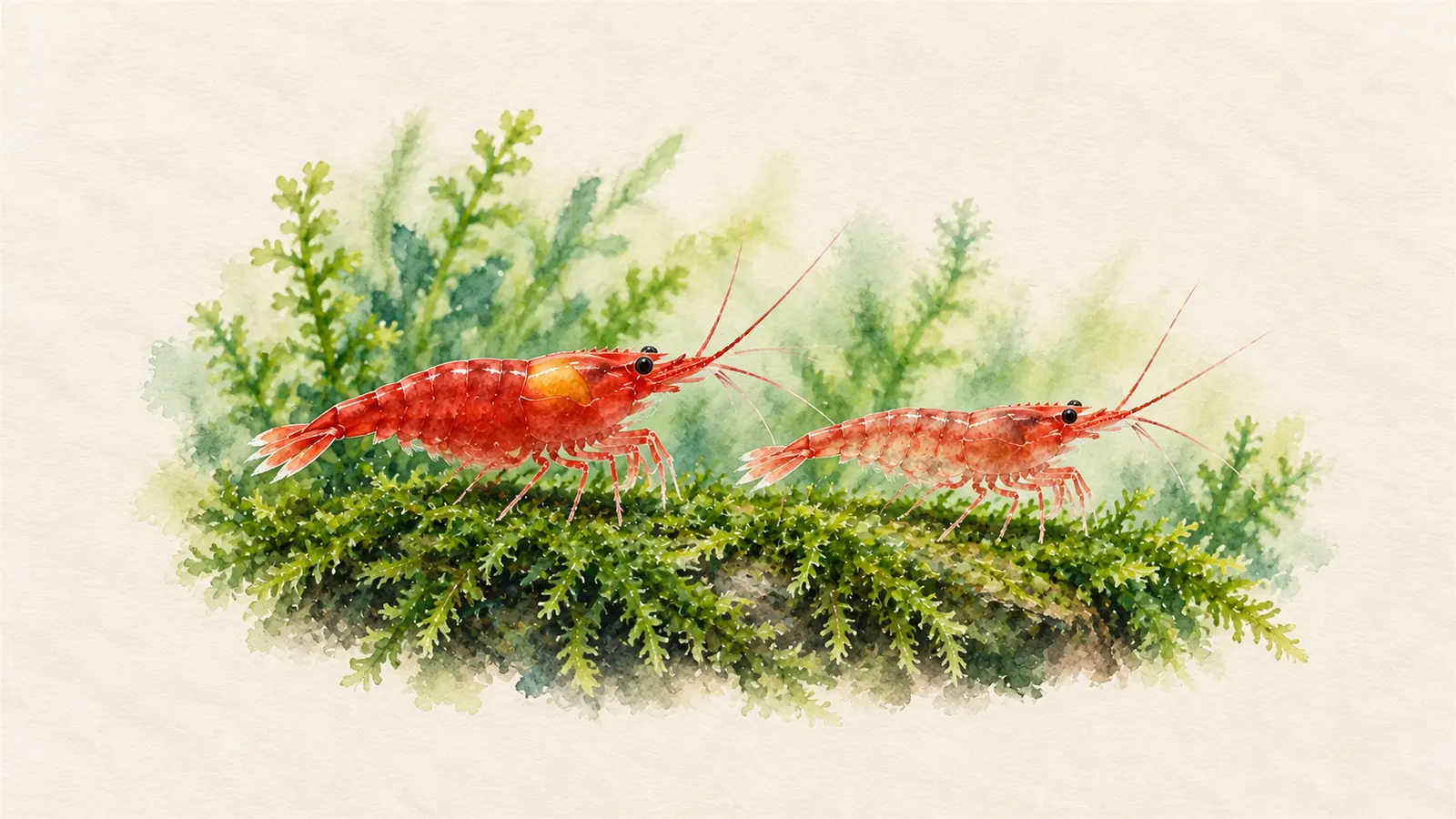
First, patience: you cannot sex babies
In newly hatched and few-week-old shrimp there is no visible difference between males and females. The differences become clear as shrimp mature; for Neocaridina that is usually around 3–4 months of age, or roughly 1.5–2 cm (about 0.6–0.8 in) long. Some females mature late and can look like males for a while. So do not rush to look at a young group and declare "they're all males."
Five signs in Neocaridina
1. Size: females are bigger
Mature females are noticeably larger than males. Scientific studies back this up: females have a longer carapace and a longer spike on the head (the rostrum), and their bodies are fuller. But this sign only works when you see shrimp of the same age side by side. If your tank has shrimp of different ages, you can easily mistake a small female for a male.
2. Belly line: the most useful sign
Watch your shrimp from the side and look at the lower line of its belly. In a female, the belly curves downward, a bit like a "D" lying on its side. The side plates on the first body segments are wide and rounded; they form a kind of pouch for carrying eggs. In a male, the belly line runs straight from the body to the tail, and the shrimp looks slimmer and more triangular. Scientific studies have measured that the second abdominal plate is longer and wider in females, which is what hobbyists mean when they say "the female's belly hangs lower."
3. Saddle: the female's ID card
On a mature female's back, just behind the head, you will see a yellowish, greenish or orange patch. Hobbyists call it the saddle; it is developing eggs. If you see a saddle, that shrimp is definitely female. But not seeing a saddle does not mean it is a male: young females may not have one yet, and in dark lines such as chocolate, black or deep red it may be hidden under the shell.
4. Eggs: the undisputed answer
A shrimp carrying tiny balls under its belly, between its swimmerets, is a female. Do not confuse eggs with a long, thin greenish layer of fungus: eggs are round and distinct. For the egg stage, see our egg guide.
5. Color: helpful but misleading
In low-grade lines such as ordinary cherry shrimp, females are usually darker and more solidly colored, while males are paler and more see-through. But in high-grade lines (for example deep Fire Red or Bloody Mary), males can be just as intensely colored as females. So color alone is not enough to decide; use it as a clue that supports the other signs.
A behavior clue: the mating dance
After a female molts, she releases a scent into the water and the males start swimming excitedly and fast all over the tank. Hobbyists call this the "mating dance." The ones racing around madly are the males; the female usually hides in a corner. If you have seen this behavior, you also know you have both females and males in your tank. One caveat: fast swimming right after a large, sudden water change can be a sign of stress. For details, see our water change guide.
Table: female and male side by side
| Sign | Female | Male | Reliability |
|---|---|---|---|
| Size | Larger, fuller | Smaller, slim | Medium (age differences mislead) |
| Belly line | Curves downward, "D" shaped | Straight, triangular | High |
| Saddle | Present in mature females | None | Certain if visible |
| Eggs | Under the belly | None | Certain |
| Color (in low-grade lines) | More solid, darker | Paler, see-through | Low, supporting clue only |
| After a molt | Hides | Swims fast | Medium |
The certain but impractical method: the swimmerets
Scientifically, the most certain way to tell the sexes apart is by the swimmerets (pleopods) under the belly. In male Neocaridina, the inner branch of the first swimmeret is swollen and pear-shaped, and the second swimmeret has a small rod-shaped projection called the "appendix masculina." Females do not have these structures. This difference is also used in species descriptions. But seeing these sub-millimeter structures usually means examining the shrimp under a microscope. You are unlikely to see them on a live shrimp with a phone or a magnifying glass, so this is a lab method, not a tank-side one.
Common mistakes
- Mistaking a young female for a male: a small female without a saddle yet looks a lot like a male. Check again in a few weeks.
- Mistaking a pale female for a male: stress, shipping or a light-colored substrate can make a female look pale too. Go by the belly line, not the color.
- Mistaking an empty shell for a dead shrimp: if you see a transparent shell, it is usually a healthy molt. See the molting guide.
- Relying on a single sign: if two or three signs point the same way, your call is most likely right.
Female-to-male ratio when starting a colony
Many sellers and hobbyists recommend starting a new colony with two or three females for every male; a single male can fertilize more than one female. But you do not need to pick shrimp one by one to hit that ratio. One study shows that the sex ratio of shrimp offspring is genetically determined and roughly half and half. So if you buy 10 shrimp at random, you very likely have both females and males.
An interesting note: a study from Turkey suggests that water temperature may affect the female-to-male ratio of offspring; more females were observed in cooler water and more males in warmer water. However, this result contradicts the other study showing that sex is genetically determined, and the question is not settled yet. If your colony keeps tilting toward one sex, noting your tank temperature could make for an interesting observation.
Caridina and Amano shrimp
Caridina (Crystal Red, Taiwan Bee)
The basic signs are the same: females are larger, with a lower, curved belly; males are slimmer. But bold white and red patterns can make the saddle and belly line harder to see. In Caridina, the link between color and sex is not as reliable as in Neocaridina.
Amano shrimp
Mature Amano females are clearly bigger (about 5–6 cm, or 2–2.4 in, versus 4–4.5 cm, or 1.6–1.8 in, for males) and look fuller. Females may show a greenish-gray egg patch behind the head. There is also a method based on the dots along the side of the body: the common view on hobby forums is that females' bottom row of markings forms long dashes, while males' are evenly spaced dots. But sources contradict each other on this, and the markings are only clear in older shrimp. Size and body fullness are more reliable. For breeding Amanos, see the Amano shrimp guide.
Frequently asked questions
My shrimp have not had eggs in months. Are they all males?
Possibly, but there are more likely reasons: your shrimp may not be mature yet, your water values may be fluctuating, or the tank may be newly set up. First check the belly line and the saddle, then go over the conditions in our breeding guide.
Do male shrimp harm females?
No. However frantic the mating dance looks, it does not harm the female. Trying to move her to a separate container stresses her more.
Can a shrimp change sex later?
Neocaridina are not known to change sex. Most "the shrimp I thought was a male got berried" stories come from a young female being misidentified.
Sources
- Sganga et al. (2016), body measurements and sex differences in Neocaridina davidi: abstract (scientific)
- Shih, Cai and Chiu (2019), ZooKeys 817, male swimmeret structures in Neocaridina: article (scientific)
- Tropea and López Greco (2019), Canadian Journal of Zoology 97: genetic determination of sex ratio: record (scientific)
- Serezli et al. (2017), effect of temperature on sex ratio in cherry shrimp: record (scientific)
- The Shrimp Farm: Sexing Neocaridina dwarf shrimp (breeder)
The values and advice in this guide reflect what is widely accepted in the shrimp hobby. They can vary with the line, your water and the breeder your shrimp came from. Make changes to your tank in small steps.