
Shrimp-Safe Rocks and Driftwood: What to Use and What to Test
Rocks and wood make a shrimp tank look like a landscape, and shrimp love them: every surface grows the biofilm they graze on all day. But hardscape isn't just decoration. Some rocks slowly dissolve and change your water, and some wood brings along things you don't want. For cherry shrimp this is usually a small matter. For Crystal Red and other Caridina kept in soft water, the wrong rock can quietly undo everything your substrate and remineralized water are doing. This guide sorts hardscape into what's generally safe, what needs testing, and what to leave out.
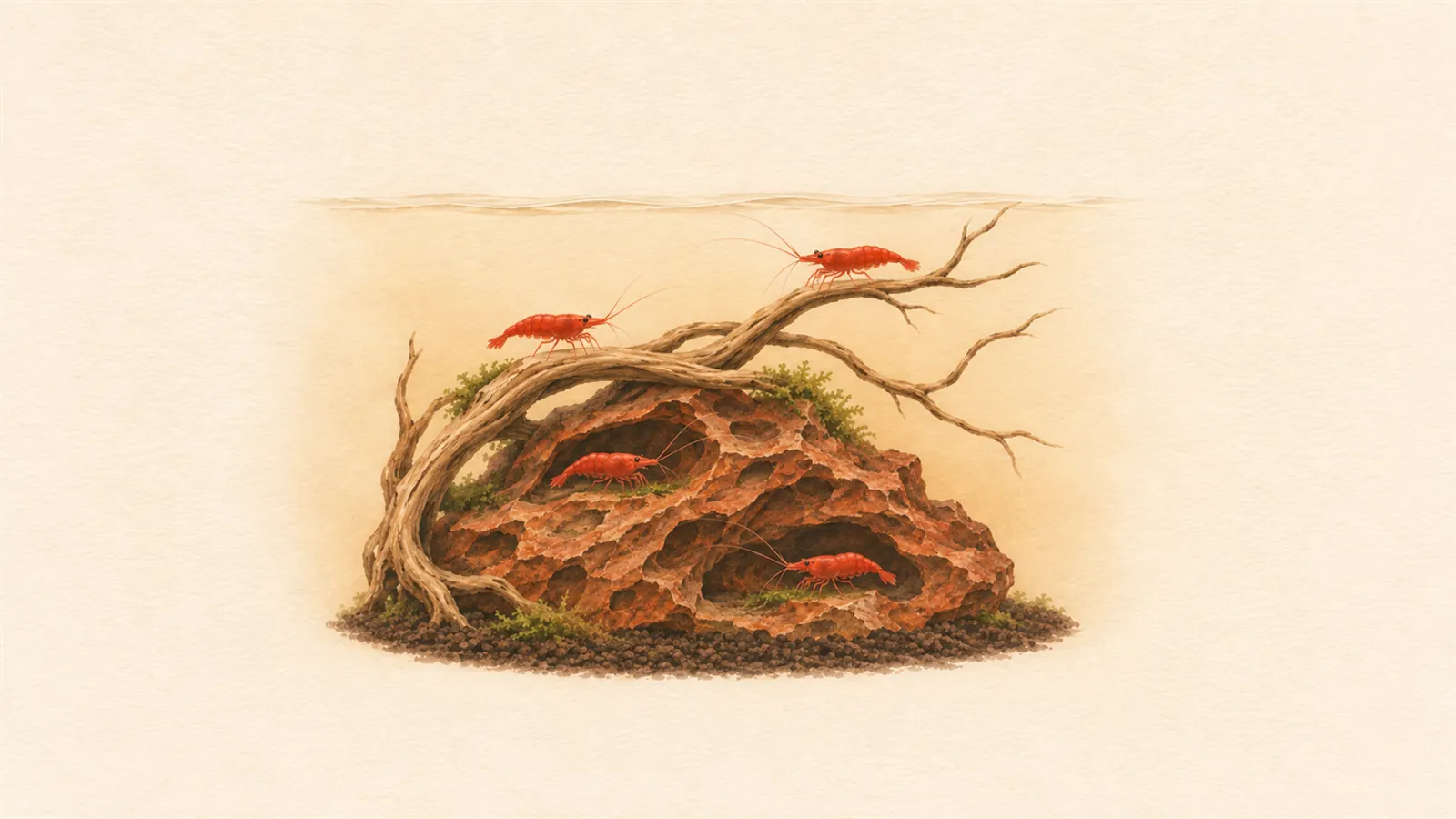
Why rocks matter more for some shrimp than others
Rocks that contain calcium carbonate (limestone, marble, many "reef" rocks) dissolve slowly in water, and as they do they raise GH and KH, which pushes pH up. The effect depends on how much rock you use relative to the water volume, and on how soft and acidic your water is: carbonate dissolves faster in acidic water.
- Neocaridina (cherry, Blue Dream, yellow) live comfortably in moderately hard water. A rock that adds a little hardness is rarely a problem, and some keepers even use it to steady soft tap water. The thing to avoid is a change, not hardness itself.
- Caridina (Crystal Red, Taiwan Bee) are kept in soft water with KH near zero, usually over active substrate that holds pH low. A carbonate rock fights the substrate, exhausts its buffering faster, and drags the water away from where these shrimp are comfortable. See the Caridina care guide for target values.
Rocks that are generally inert
These are widely used in shrimp tanks because they don't release carbonates: dragon stone (also sold as ohko stone), lava rock, quartz, granite, slate and petrified wood. Lava rock and dragon stone are also full of holes and texture, which means more surface for biofilm and more hiding places for shrimplets.
"Generally" matters here. Rock is a natural material, and products sold under the same name can come from different places. Treat this list as a starting point, not a guarantee, and still run the test below.
Seiryu stone: popular, but not neutral
Seiryu is one of the most popular aquascaping stones, and it's often labeled "shrimp safe." Hobbyist measurements tell a more nuanced story: Seiryu contains calcium and can raise GH and KH, and the more of it you use in a given volume, the bigger the effect. In a cherry shrimp tank that's usually fine. In a Caridina tank, either skip it or use it sparingly and watch your KH and TDS for the first weeks.
There's a second catch: cheap "Seiryu" is sometimes another limestone-type rock that raises hardness far more than real Seiryu does. If a stone you bought changes your water more than expected, that may be the reason.
Rocks to keep out of soft-water tanks
Limestone, marble, Texas holey rock, coral and crushed coral, and aragonite are made to raise hardness. They have a place in African cichlid tanks, but not in a Caridina tank, and they're unnecessary in most Neocaridina tanks too. Our substrate guide covers the sand and gravel versions of these.
Test any rock before it goes in
Two simple tests catch almost every problem rock:
- The vinegar test. Clean and dry the rock, then drip a few drops of white vinegar on it. Fizzing or bubbling means it contains carbonate and will raise hardness. No fizz is a good sign, but not proof: some rocks leach minerals slowly without reacting to vinegar.
- The bucket test. Put the rock in a bucket of the water you use for your tank. Measure GH, KH and TDS at the start and again after about a week. If the numbers climb, the rock is changing your water.
For a Caridina tank, the bucket test is worth the week it takes. For a Neocaridina tank, the vinegar test alone is usually enough.
Driftwood and other wood
Wood is a shrimp favorite: it grows biofilm, gives shelter, and softens slowly over time into something shrimp graze on. Aquarium driftwood, cholla (the hollow skeleton of a cactus, popular in shrimp tanks) and spider wood are common choices.
Most wood releases tannins, which tint the water tea-colored and can lower pH slightly. For shrimp this is harmless, and many Caridina keepers welcome it. If you don't like the color, soaking the wood for longer and doing water changes reduces it over a few weeks.
Preparing wood: scrub it under water with a brush (no soap), then soak or boil it. Boiling helps waterlog it so it sinks and drives out some of the tannins; cholla in particular often floats for days unless it's boiled or weighted down. A thin white fuzz that sometimes appears on new wood in the first weeks is common and usually fades on its own; shrimp and snails often eat it.
Collected wood: wood picked up from rivers, beaches or parks can carry pesticides, pollutants or organisms you can't see, and boiling doesn't remove everything. If you're not sure where a piece came from, wood sold for aquarium use is the safer choice for a shrimp tank.
Arranging hardscape for shrimp
Shrimp don't need an elaborate layout, but a few choices help them:
- Surface over size. Rough, porous rocks and branchy wood give more grazing area than a few smooth stones.
- Hiding spots. Gaps between rocks and under wood give molting shrimp and shrimplets somewhere safe.
- Stability. Set rocks firmly on the tank bottom or deep in the substrate so they can't shift and trap a shrimp.
Sources
- GC Shop: Shrimp-safe vs risk stones (retailer guide; inert and reactive rocks)
- Gensou: How to Test if Aquarium Rocks Are Safe (vinegar and soak tests, and their limits)
- PetShrimp forum: keeper discussion on Seiryu stone (hobbyist reports of rising GH and pH)
- LiveAquaria: Adding Driftwood to Your Aquarium (retailer guide; preparing wood)
- Hepper: How to Find and Prepare Driftwood (risks of collected wood)
The values and advice in this guide reflect what is widely accepted in the shrimp hobby. They can vary with the line, your water and the breeder your shrimp came from. Make changes to your tank in small steps.
Stuck on something? Ask the community; you can add a photo of your tank and your water parameters.