
Choosing a Shrimp Tank Substrate: Sand, Gravel or Active Substrate?
When setting up a tank, the substrate is often the last thing people think about: "I'll put some sand on the bottom and that'll do." For cherry shrimp, it usually really does. But if you are thinking about keeping Crystal Red, the substrate becomes one of the most important parts of the tank, because it shapes the water chemistry. In this guide we explain why substrate makes such a difference in a shrimp tank, which one suits which shrimp, and how to test a substrate before it goes into the tank.
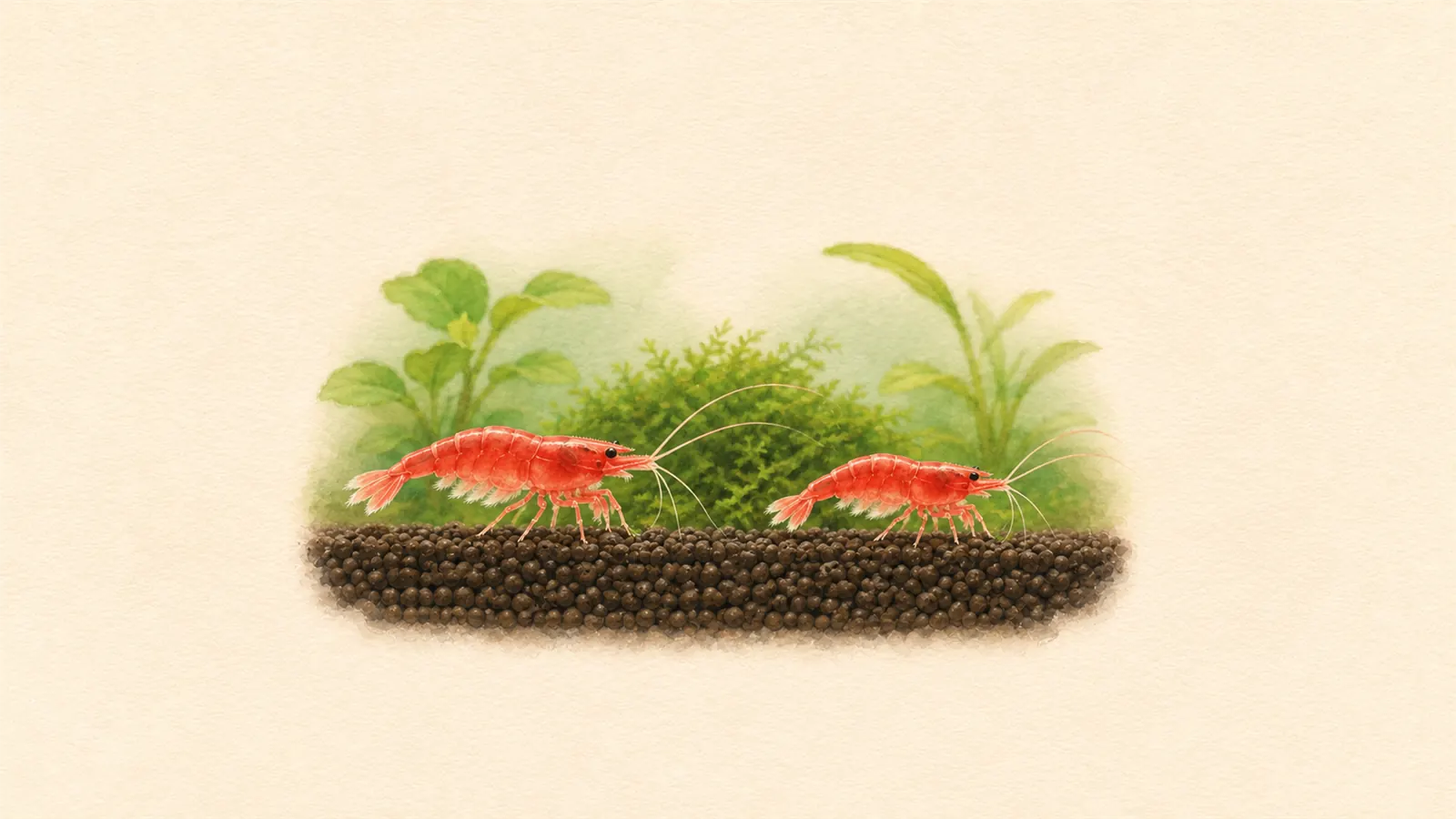
Substrates that change the water, and substrates that don't
From a shrimp keeper's point of view, it makes things much easier to split aquarium substrates into two groups:
- Inert substrate: sand, quartz gravel and the like. It does not change your water parameters; whatever your tap water is, your tank water will be too. Its advantage is simplicity; its drawback is that it does nothing to correct your water.
- Active (buffering) substrate: also called active soil or "aqua soil", these are granules of baked soil. It softens the water, pulls KH out of it, and lowers pH and holds it within a certain range. In doing so, it pulls your water parameters in the direction it wants, which is why it matters so much which shrimp you use it with.
There is also a third group: substrates that harden the water. Substrates containing calcium carbonate, such as coral sand, crushed coral and aragonite, slowly dissolve over time; they raise GH and KH and keep pH high. They are used for some fish that like hard water, but in a shrimp tank they usually cause problems (more on that below).
For cherry shrimp: a simple substrate is enough
Neocaridina (cherry shrimp, Blue Dream, yellow, orange…) do well in moderately hard water close to neutral. Many tap waters are close to this range, so there is no need for a substrate that changes the water. Still, don't assume until you have tested your own water (see the water parameters guide). Inert sand or fine gravel is enough.
- Color: A dark substrate makes shrimp look more vivid. Red and blue lines look noticeably brighter on a black or dark brown substrate. This only affects how they look; it does not change the shrimp's genetic color.
- Depth: Around 3–5 cm is enough both for plant roots and for shrimp to pick through the substrate.
- Plant substrate: If you are putting a layer of plant substrate underneath for your plants, make sure it contains no copper and no fertilizer additives that are harmful to shrimp. Copper is one of the most dangerous substances for shrimp.
Can cherry shrimp go on active substrate?
Yes; many hobbyists keep Neocaridina in planted tanks with active substrate. But there is a conflict you should know about: active substrate tries to pull pH below 7 and lower KH, while Neocaridina prefer somewhat harder water. If you are also adding a mineral that raises GH/KH, the substrate and the mineral work against each other, and your parameters never quite settle. This is a situation often described on hobby forums. If you are just starting out, inert substrate is both cheaper and more predictable for Neocaridina.
For Crystal Red and Caridina: why is active substrate almost a must?
Caridina shrimp such as Crystal Red, Crystal Black and Taiwan Bee live in soft, slightly acidic water: pH around 5.8–6.8, with KH close to zero. The problem is this: with KH close to zero, the water has no buffer left to keep pH stable, and pH can swing easily. Active substrate fills exactly this gap; it pulls pH into the desired range and holds it there. That is why almost all Caridina tanks use active substrate, and the water is usually prepared with RO water and shrimp minerals.
Knowing two habits of active substrate helps you avoid the most common disappointments:
Ammonia in the first weeks. New active substrate, especially the types that contain nutrients, releases ammonia into the water during the first weeks. Sources generally give anywhere from a few weeks to a month for this phase. This is why cycling a tank with active substrate can take longer than usual. Before adding shrimp, confirm by testing that ammonia and nitrite have dropped to zero; trust the test, not the calendar.
Its buffering capacity can run out. Active substrate works by pulling KH and minerals into itself; past a certain point, it becomes saturated. This is usually noticed within 1–1.5 years; some sources say it can stretch to as long as 2 years. How long it lasts depends on the hardness of the water you use and how often you do water changes: a substrate fed with hard water is used up much faster. The signs usually come in this order: pH slowly creeps up toward 7, KH starts to show up on tests, and molting problems in the shrimp and losses after water changes may appear. If you see these signs, plan to replace the substrate.
Does substrate matter for Amano shrimp?
Not much. Amano shrimp adapt to a wide range of water and have no special substrate requirements. Whatever tank they will live in, the substrate chosen for the other animals there will suit Amano as well. For details, see the Amano care guide.
Test a substrate before it goes into the tank: the vinegar test
Sand collected from nature, gravel you know nothing about, or a stone you want to put in your tank can quietly harden your water. The simplest way to find out is the vinegar test:
- Clean a handful of the sand, or the stone, and dry it.
- Put a few drops of white vinegar on it.
- If you see foaming or fizzing, the material contains calcium carbonate. In the tank, it will slowly dissolve and raise GH and KH.
If it fizzes, keep the material out of a Caridina tank. For Neocaridina, slight hardening is usually not a problem, but be aware that your parameters will change over time. One caveat: passing the test does not prove the material is completely inert; some stones can slowly release minerals without reacting to vinegar. If in doubt, leave the material in a bucket of water for a few days and measure GH, KH and TDS before and after.
Substrates at a glance
| Substrate | Effect on water | Cherry shrimp | Crystal Red |
|---|---|---|---|
| Sand, quartz gravel (inert) | No change | Very suitable | Not enough on its own; no pH buffer |
| Active substrate | Softens, lowers pH and keeps it stable | Usable; monitor parameters | Standard choice |
| Coral sand, crushed coral, aragonite | Raises GH, KH and pH | Not needed | Not suitable |
| Plant substrate (bottom layer) | Depends on what it contains | Usable if free of copper and fertilizer additives | Not recommended; active substrate can already carry nutrients |
If you'd like to see water parameters and substrate recommendations by species on a single page, take a look at the shrimp finder.
Sources
- Shrimp Science: What is an active substrate? (hobby guide; how active substrate works)
- Buce Plant: Planted Shrimp Tank: What is the Best Substrate? (plant and shrimp seller guide)
- The Shrimp Farm: Aqua Soil Amazonia (breeder guide; ammonia phase of new substrate)
- Aquarium Science: Buffering substrates (substrates that harden water)
- Gensou: How to Test if Aquarium Rocks Are Safe (the vinegar test and its limits)
- SKF Aquatics forum: substrate discussions (hobbyist experiences of active substrate conflicting with minerals)
The values and advice in this guide reflect what is widely accepted in the shrimp hobby. They can vary with the line, your water and the breeder your shrimp came from. Make changes to your tank in small steps.
Stuck on something? Ask the community; you can add a photo of your tank and your water parameters.