
Sponge Filters: The Quiet Hero of the Shrimp Tank
Look into a shrimp keeper's tank and you will often see the same thing: a round, grey sponge in one corner with bubbles rising out of it. Plain, cheap and quiet. But it is not habit that makes it so common in shrimp tanks; the sponge filter happens to suit what shrimp need almost perfectly, more or less by accident. In this guide we explain how it works, how to choose one, and what to watch out for where it most often goes wrong: cleaning.
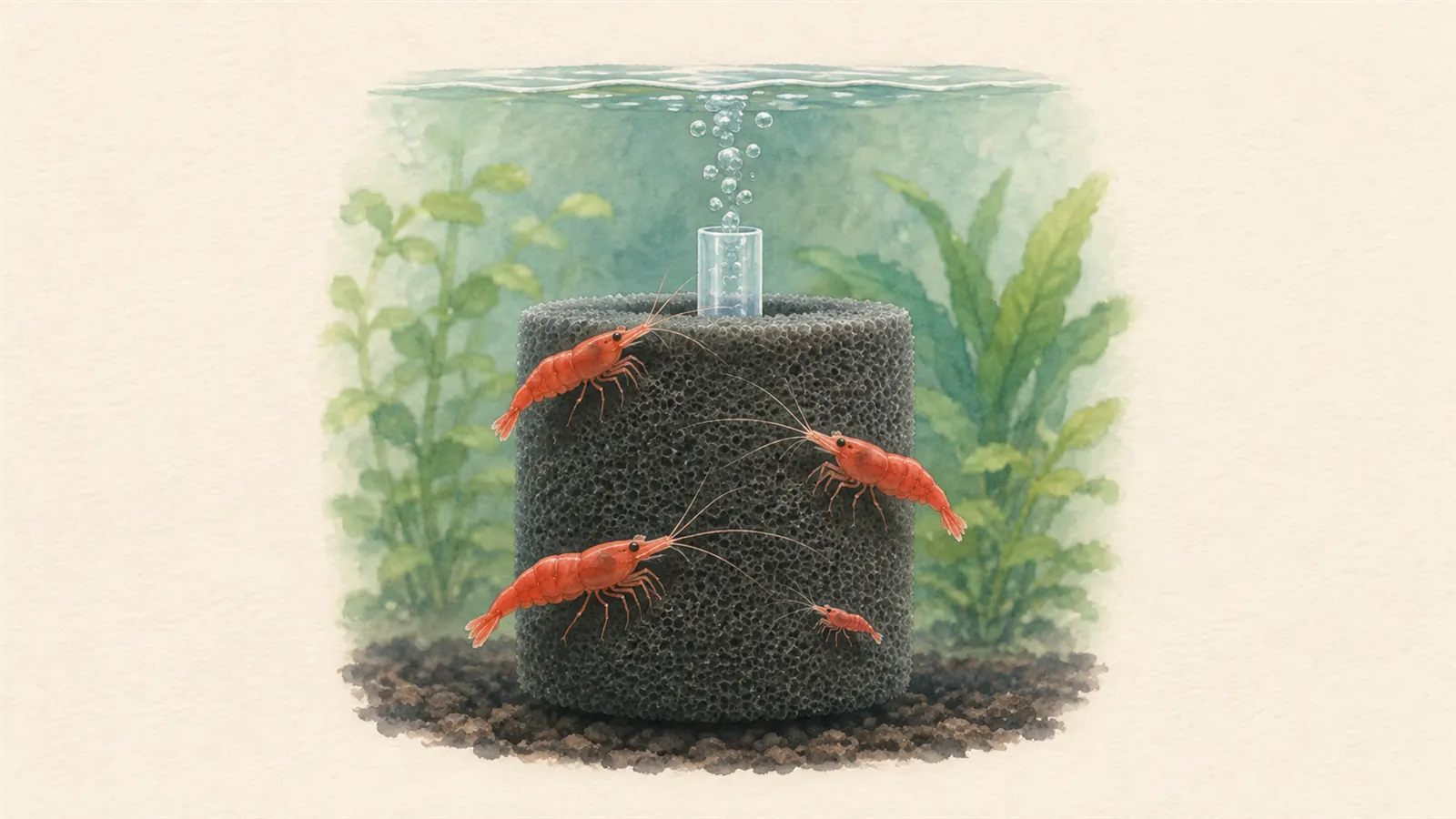
A filter powered by bubbles
There is no motor inside a sponge filter. An air pump outside the tank sends air through a thin airline into the tube in the middle of the sponge. The bubbles rising up the tube carry water upward with them, and new water is drawn in through the sponge to replace it. This way the tank's water passes slowly and continuously through the sponge.
Meanwhile, the sponge does two jobs at once:
- Mechanical filtration: It traps leftover food and floating particles in its pores.
- Biological filtration: Over time, beneficial bacteria that convert ammonia and nitrite settle on the surfaces of the pores. This is the part that carries the tank's nitrogen cycle.
The rising bubbles also stir the water surface, which helps oxygen mix into the water. We explain why this matters on hot summer days in the summer heat guide.
Why do shrimp love it so much?
It doesn't swallow babies. The intake of a powered filter can pull in baby shrimp only a few millimeters long, and these are among the hardest losses to notice. A sponge filter has no intake that sucks; water enters slowly across the whole surface of the sponge.
It sets its own dinner table. Over time, a thin layer of bacteria and microalgae called biofilm forms on the surface of the sponge. Shrimp, especially babies, graze on this layer all day long. That is why you see shrimp gathering on a sponge filter.
Its flow is gentle. Shrimp don't like strong current. A sponge filter's flow is adjusted by the amount of air, and it generally stays gentle.
It is cheap and simple. There is no impeller or seal to break. As long as the air pump runs, the filter runs.
It has its limits, too
A sponge filter is not the one right answer for every tank. In heavily stocked or large tanks it may not be enough on its own, and in densely planted tanks with CO2 injection, bubbles constantly aerating the water may be unwanted. In these tanks, a common solution is to use a powered filter and fit a pre-filter sponge over its intake. This is what really matters for baby safety: whichever filter you use, don't leave an open intake that babies can get into.
Choosing the right size
Sponge filters are usually sold with a volume rating such as "up to 40 liters". Sources commonly warn that these ratings are optimistic. It is safer to choose one size larger than your tank calls for, or to use two small sponges.
Using two sponges has another advantage: you can clean them in turns. While one is being cleaned, the bacteria in the other stay in place, and the cycle is not disturbed.
Pore size: fine or coarse?
A sponge's pore size is usually described in PPI (pores per inch). A coarse sponge clogs more slowly and keeps its flow for longer. A fine sponge traps smaller particles but needs cleaning more often. Sources disagree on which is better for shrimp: some recommend a medium grade, others a finer sponge in tanks with babies. In practice, two things are enough: the sponge should be dense enough that babies cannot get inside it, and the flow should keep going without clogging.
The air pump and the check valve
What actually determines a sponge filter's performance is the air pump. The deeper the tank, the harder it is for the pump to push air down to the bottom; deep tanks need a stronger pump. A small air control valve fitted to the airline lets you turn the flow up or down to suit your shrimp.
There is one more part most people forget during their first setup: the check valve. If the air pump sits below the tank's water level, tank water can flow back through the airline toward the pump when the power goes out or the pump stops. A small one-way check valve fitted to the airline prevents this. It is a cheap part, but it saves both the pump and the floor.
Cleaning the sponge the right way
Cleaning is the part of sponge filter care that people get wrong most often. Over time the sponge fills up; the bubbles decrease and the flow weakens. That is the sign it is time to clean it. How often depends on how heavily stocked the tank is and how fine the sponge is; the best signal is weaker flow, which in most tanks means somewhere between every few weeks and every two months. Watching the flow is more reliable than following a calendar.
- During a water change, put the water you take out of the tank into a container.
- Switch off the air pump and slowly lift the sponge out of the tank. First shake any shrimp on it off into the tank water.
- Gently squeeze the sponge a few times in this tank water. The aim is to get rid of the dirt, not to make the sponge spotless.
- Put the sponge back in place and switch the pump on.
Don't rinse it under the tap, and don't use soap or hot water. The chlorine in tap water and the difference in temperature kill some of the beneficial bacteria in the sponge; ammonia and nitrite can rise in the tank again. For the same reason, on a day you do a large water change, it is safer to spread these jobs over different days rather than also cleaning the sponge from top to bottom.
Sources
- Garnelio: Shrimp friendly and safe: the sponge filter (shrimp seller guide; how it works, baby safety)
- Chewy: When To Use Sponge Filters for Fish Tanks (pet care guide; advantages and limits)
- Gensou: Sponge Filters Compared: Aquarium Size and Flow Guide (seller guide; size ratings, cleaning frequency)
- Aquarium Co-Op forum: Sponge filter PPI (hobbyist discussion; choosing pore size)
- UKAPS forum: Shrimp safe filter for 35l tanks (hobbyist discussion; pre-filter sponge on a powered filter)
The values and advice in this guide reflect what is widely accepted in the shrimp hobby. They can vary with the line, your water and the breeder your shrimp came from. Make changes to your tank in small steps.
Stuck on something? Ask the community; you can add a photo of your tank and your water parameters.